
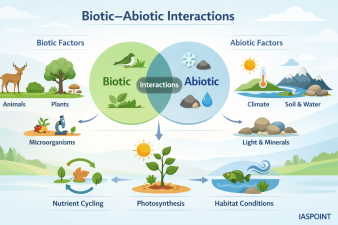
In an ecosystem, biotic (living) and abiotic (non-living) components do not exist in isolation; they are linked through a complex web of interactions. These interactions facilitate the flow of energy and the cycling of nutrients, ensuring the stability and functional integrity of the biosphere.
Mechanisms of Interaction
The relationship between the living community and the physical environment is characterized by two primary processes: Environmental Forcing (the environment shaping the organism) and Niche Construction (organisms altering their environment).
1. Environmental Influence on Biotic Components
Abiotic factors act as “limiters” that define the survival threshold for species.
- Photoperiodism: The duration of sunlight affects the flowering of plants, migration of birds, and breeding cycles of animals.
- Temperature Sensitivity: Metabolic activities are temperature-dependent. For instance, coral bleaching occurs when sea surface temperatures rise, disrupting the symbiotic relationship between coral polyps and zooxanthellae.
- Soil Chemistry: The availability of nitrogen, phosphorus, and potassium (N, P, K) in the soil dictates the primary productivity of a region.
- Water Salinity: Determines the distribution of aquatic life, separating freshwater species (Stenohaline) from marine species.
2. Biotic Influence on Abiotic Components
Living organisms actively modify their physical surroundings to maintain ecological balance.
- Atmospheric Regulation: Plants maintain the balance of O2 and CO2 through photosynthesis and respiration.
- Soil Formation (Pedogenesis): Microorganisms and lichen break down rocks into soil. Earthworms (detritivores) improve soil aeration and nutrient profile.
- Microclimate Creation: Dense forest canopies reduce the amount of sunlight reaching the ground, maintaining higher humidity and lower temperatures compared to open areas.
- Geological Modification: Coral polyps extract calcium carbonate from seawater to build massive reef structures, which eventually form islands and protect coastlines from erosion.
Nutrient Cycling: The Biogeochemical Interface
Nutrients move from the abiotic environment into living organisms and are eventually returned to the environment. These cycles are categorized based on their reservoir.
| Cycle Type | Primary Reservoir | Examples | Key UPSC Fact |
| Gaseous Cycles | Atmosphere or Hydrosphere | Carbon, Nitrogen, Oxygen, Water | Generally faster; nutrients are rarely lost from the cycle. |
| Sedimentary Cycles | Earth’s Crust (Lithosphere) | Phosphorus, Sulphur | Slower; nutrients may get locked in sedimentary rocks for ages. |
Energy Flow and Thermodynamic Laws
The interaction is governed by the laws of thermodynamics, ensuring that the ecosystem remains an open system.
- First Law of Thermodynamics: Energy is neither created nor destroyed but transformed. Solar energy is transformed into chemical energy by plants.
- Second Law of Thermodynamics: During energy transfer, some energy is always lost as heat. This limits the number of trophic levels in an ecosystem as energy becomes insufficient to support higher levels.
Adaptive Interactions and Responses
Organisms evolve specific traits to survive abiotic stresses, a process critical for UPSC Prelims.
- Morphological Adaptations: Cacti have spines instead of leaves to reduce transpiration; Mangroves have pneumatophores (respiratory roots) to survive in anaerobic, saline soil.
- Physiological Adaptations: High-altitude adaptation in humans (increased RBC production) to cope with low partial pressure of Oxygen.
- Ethological (Behavioral) Adaptations: Desert animals like the Fennec Fox are nocturnal to avoid extreme daytime heat.
Key Ecological Indicators
- Biological Oxygen Demand (BOD): An indicator of the amount of dissolved oxygen needed by aerobic organisms to break down organic matter in water. High BOD indicates high organic pollution (Abiotic-Biotic imbalance).
- Eutrophication: A process where excess abiotic nutrients (Nitrates/Phosphates) lead to an explosion of biotic growth (Algal Bloom), eventually depleting oxygen and killing aquatic life.
Ecological Succession: Time-based Interaction
Succession is the process by which the structure of a biological community evolves over time following a change in abiotic conditions.
- Primary Succession: Occurs in a barren area where no soil exists (e.g., bare rock, newly cooled lava).
- Secondary Succession: Occurs in areas where a natural community has been destroyed but soil remains (e.g., after a forest fire or abandoned cropland).