
Decomposition is a complex biological and chemical process by which complex organic matter (detritus) is broken down into simpler inorganic substances such as carbon dioxide (CO2), water (H2O), and nutrients (e.g., Nitrogen, Phosphorus). It is the vital “recycling” mechanism of an ecosystem that replenishes the Standing State of the soil.
Detritus: The Raw Material
The raw material for decomposition is called Detritus. It consists of dead plant remains (leaves, bark, flowers) and animal remains, including fecal matter. The organisms that initiate this process are called Detritivores (e.g., Earthworms) and Decomposers/Saprotrophs (e.g., Fungi, Bacteria).
Five Stages of Decomposition
Decomposition occurs through a series of synchronized physical and chemical steps:
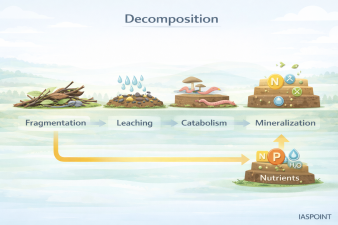
- Fragmentation: Detritivores (like earthworms) break down detritus into smaller particles. This increases the surface area for microbial action.
- Leaching: Water-soluble inorganic nutrients move down into the soil layers and get precipitated as unavailable salts.
- Catabolism: Bacterial and fungal enzymes degrade detritus into even simpler inorganic compounds.
- Humification: This leads to the accumulation of Humus, a dark-colored, amorphous substance.
- Trivia: Humus is highly resistant to microbial action and decomposes extremely slowly. It serves as a reservoir of nutrients.
- Mineralization: The final step where the humus is further degraded by some microbes to release inorganic nutrients back into the soil.
Factors Influencing Decomposition Rate
The rate of decomposition is not constant; it is highly regulated by the chemical composition of detritus and climatic factors.
1. Chemical Composition of Detritus
- Slower Rate: If detritus is rich in Lignin and Chitin (complex organic polymers).
- Faster Rate: If detritus is rich in nitrogen and water-soluble substances like Sugars.
2. Climatic Factors
- Temperature and Soil Moisture: These are the most important factors.
- Warm and Moist environment favors rapid decomposition.
- Low temperature and Anaerobiosis (lack of oxygen) inhibit decomposition, leading to the buildup of organic matter (e.g., Peat formation in bogs).
3. Aerobic vs. Anaerobic Conditions
- Decomposition is largely an oxygen-requiring process (aerobic). In the absence of oxygen, the process slows down significantly and produces different byproducts like methane (CH4).
Comparison of Decomposition Rates by Biome
| Biome | Decomposition Rate | Reason |
| Tropical Rainforest | Very Fast | High temperature and high humidity year-round. |
| Temperate Forest | Moderate | Seasonal changes; slow in winter, fast in summer. |
| Tundra / Arctic | Very Slow | Low temperatures inhibit microbial activity; presence of permafrost. |
| Desert | Slow | Lack of moisture limits the survival of decomposers. |
Functional Significance in Ecosystems
- Nutrient Cycling: It converts organic molecules back into a form that plants can re-absorb.
- Carbon Sink/Source: Decomposition releases CO2 into the atmosphere. If the rate of production (photosynthesis) exceeds decomposition, the ecosystem acts as a carbon sink.
- Soil Fertility: Humification improves soil structure, aeration, and water-holding capacity.
Key Terms for UPSC Prelims
- Saprotrophs: Organisms that obtain nutrients by absorbing organic matter from dead organisms (extracellular digestion).
- Peat: Partially decomposed organic matter accumulated under anaerobic, acidic, and waterlogged conditions.
- Mineralization: The specific transition from an organic form of an element to an inorganic state.
- Litter: The top-most layer of freshly fallen organic material that has not yet undergone significant decomposition.