
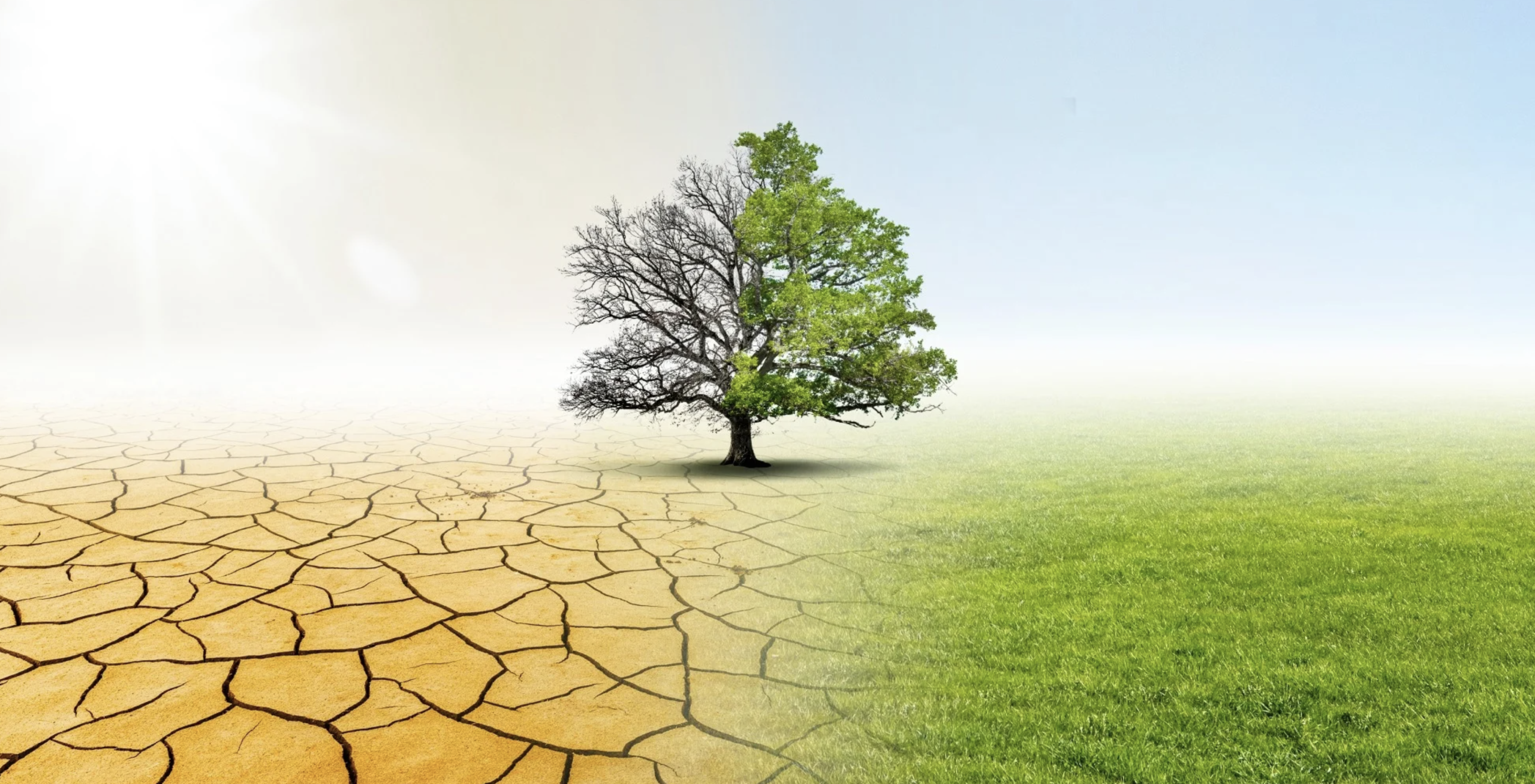
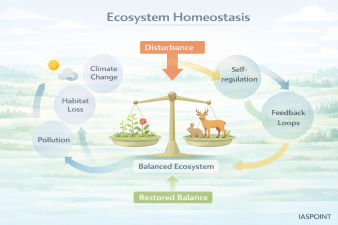
Ecosystem Homeostasis is the inherent capacity of an ecosystem to maintain its structural and functional stability despite external perturbations. It refers to a state of dynamic equilibrium where the system regulates itself through various feedback mechanisms. The word is derived from the Greek words homoios (similar) and stasis (standing still).
Mechanism of Self-Regulation
Ecosystems are not static; they are constantly subjected to stresses like storms, fires, or pest outbreaks. Homeostasis allows the system to return to its original state or maintain a steady state of operation.
1. Feedback Loops
Self-regulation is primarily governed by feedback loops, which are processes where the output of a system “feeds back” as an input to control future behavior.
- Negative Feedback (Stabilizing): This is the primary mechanism of homeostasis. It counteracts a change to bring the system back to balance.
- Example: If the population of deer (prey) increases, the population of tigers (predators) will eventually increase due to food abundance. This increased predation then reduces the deer population back to its normal level.
- Positive Feedback (Destabilizing): This accelerates a change, moving the system further away from equilibrium.
- Example: Global warming leads to the melting of Arctic ice. Since ice reflects sunlight (high albedo) and water absorbs it, the melting leads to further warming, causing even more ice to melt.
2. Redundancy and Diversity
An ecosystem with high biodiversity possesses “functional redundancy.” If one species fails to perform a specific role (e.g., pollination) due to a disturbance, other species can fill the niche, ensuring the system continues to function. This is often referred to as the Insurance Hypothesis.
Factors Determining Homeostatic Capacity
The ability of an ecosystem to maintain homeostasis depends on two key properties:
- Resilience: The speed at which an ecosystem returns to its original state after a disturbance.
- Resistance: The ability of an ecosystem to remain unchanged when subjected to a disturbance.
| Ecosystem Type | Resistance | Resilience |
| Tropical Rainforest | High (Hard to change due to complexity) | Low (Once destroyed, takes centuries to recover) |
| Grassland | Low (Easily burned or grazed) | High (Recovers very quickly after rain or fire) |
Limits of Homeostasis: The Tipping Point
Every ecosystem has a Homeostatic Plateau—a range of conditions within which it can self-regulate.
- Tipping Point (Threshold): If the stress exceeds the buffering capacity of the ecosystem, homeostasis fails. The system may undergo a “regime shift” and collapse or transform into a completely different state (e.g., a forest turning into a savanna due to chronic overgrazing and drought).
Anthropogenic Disruptions
Human activities often bypass or overwhelm natural homeostatic mechanisms:
- Introduction of Invasive Species: Invasive species often lack natural predators, breaking the negative feedback loop of population control (e.g., Water Hyacinth in Indian water bodies).
- Pollution: Excessive nutrient input (Eutrophication) creates a positive feedback loop of algal growth and oxygen depletion that the ecosystem cannot naturally reverse.
- Monoculture: Artificial ecosystems like wheat fields have very low homeostasis because they lack species diversity and require constant human “subsidies” (pesticides/fertilizers) to stay stable.
Key Terms for UPSC Prelims
- Gaia Hypothesis: Proposed by James Lovelock, it suggests that the Earth as a whole acts as a self-regulating, homeostatic organism.
- Cybernetics: The study of control and communication in living and non-living systems, which provides the mathematical basis for understanding feedback loops in ecosystems.
- Stable State: An ecosystem state where small perturbations are dampened by negative feedback.
- Hysteresis: A situation where an ecosystem does not return to its original state even after the initial stress is removed, indicating a permanent change in homeostatic balance.
Trivia for Aspirants
- Natural Disturbances: Small-scale disturbances like a single tree falling in a forest (Gap Dynamics) actually help maintain homeostasis by promoting local diversity and regeneration.
- Stability-Diversity Debate: While it is generally accepted that diversity increases stability, some complex ecosystems can be “fragile” because of the high interdependence of species.