
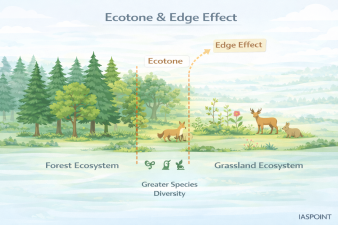
An Ecotone is a zone of junction or a transition area between two or more diverse ecosystems (biomes). It represents a tension zone where the conditions of both adjacent ecosystems overlap, creating a unique micro-environment.
- Nature of Transition: It can be narrow (e.g., between a pond and a field) or quite wide (e.g., between a forest and a desert).
- Examples:
- Mangroves: Transition between marine and terrestrial ecosystems.
- Estuaries: Transition between freshwater (rivers) and saltwater (oceans).
- Grasslands: Transition between forests and deserts.
- Riverbanks/Marshlands: Transition between aquatic and terrestrial systems.
Key Features of Ecotones
- Zone of Tension: It contains conditions intermediate to the adjacent ecosystems; hence, organisms here are often under environmental stress but highly specialized.
- Linear Structure: Ecotones often show a linear increase in the influence of one community and a decrease in the other.
- High Biodiversity: They often host a higher number of species and greater population density than the neighboring communities.
- Niche Availability: Because it shares characteristics of two biomes, it offers a wider variety of niches for different organisms.
The Edge Effect
The Edge Effect refers to the changes in population or community structures that occur at the boundary of two habitats (the ecotone).
- Definition: It is the tendency for an ecotone to have a greater variety of species and higher density of organisms than either of the flanking individual communities.
- Edge Species: These are organisms that occur primarily or most abundantly in the transition zone.
- Example: Certain species of birds find higher nesting density in the “edge” where a forest meets a grassland because they can access the shelter of the trees and the open foraging ground of the grass.
- Ecological Implications: As habitats become fragmented due to human activity (like roads through forests), the “edge” increases, which may benefit edge species but harm “interior species” that require deep, undisturbed habitats.
Comparison: Ecotone vs. Ecocline
While often confused, these terms represent different types of ecological transitions.
| Feature | Ecotone | Ecocline |
| Definition | A physical transition zone between two distinct ecosystems. | A gradual, continuous gradient of a single environmental factor. |
| Boundary | Often has visible boundaries (e.g., a shoreline). | No sharp boundaries; represents a smooth change (e.g., salinity or altitude). |
| Interaction | Focuses on species interaction and “Edge Effect.” | Focuses on physiological adaptation to a gradient. |
Significance for UPSC Prelims
- Mangroves as Ecotones: UPSC frequently tests Mangroves. They act as “bioshields,” protecting the terrestrial interior from marine storms while serving as nurseries for marine fish.
- Conservation Challenges: Ecotones are highly sensitive to climate change. For instance, as sea levels rise, the ecotone between the sea and the land shifts, leading to “Coastal Squeeze” where wetlands are lost if they cannot migrate inland.
- Wildlife Corridors: Many ecotones act as vital corridors for the migration of animals between larger habitat patches.
- Trivia: The “Edge Effect” is not always positive. In human-modified landscapes, increased edges can lead to higher rates of predation on interior species and increased vulnerability to invasive species.
Human Impact on Edges
- Fragmentation: Building a highway through a forest creates two new edges. This might increase the population of “edge-loving” species (like deer or certain crows) but leads to the local extinction of species that require “core” forest areas (like certain large cats or deep-forest birds).
- Microclimate Changes: Edges usually have higher light intensity, higher wind speeds, and lower humidity compared to the interior of a forest.