
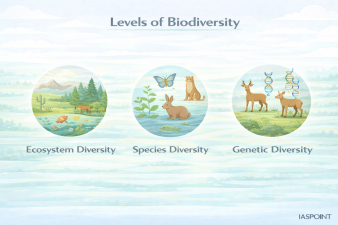
Biodiversity refers to the variety and variability of life on Earth. It is not limited to the number of species but encompasses the entire complexity of biological organization.
1. Genetic Diversity
Genetic diversity refers to the variation of genes within a single species. This variation allows populations to adapt to changing environments, diseases, and pests.
- Key Feature: It represents the heritable variation within and between populations of organisms.
- Significance: Higher genetic diversity reduces the risk of extinction. A species with low genetic diversity (e.g., Cheetahs) is more vulnerable to environmental changes.
- Examples in India: * India has more than 50,000 genetically different strains of Rice.
- There are over 1,000 varieties of Mangoes found across the country.
- Ecological Fact: Genetic diversity is the basis for Speciation (the formation of new and distinct species in the course of evolution).
2. Species Diversity
This is the most common level of biodiversity discussed and refers to the variety of species within a particular region.
- Measurement Metrics:
- Species Richness: The total number of different species present in a community.
- Species Evenness (Equitability): The relative abundance of individuals of each species. A community where all species have a similar number of individuals has higher evenness.
- Geographical Pattern: Species diversity is highest in the Western Ghats compared to the Eastern Ghats in India, particularly for amphibians.
- Global Fact: Tropical regions house nearly 70% of the world’s total species diversity.
3. Ecosystem (Community) Diversity
Ecosystem diversity refers to the variety of habitats, biotic communities, and ecological processes in the biosphere.
- Variations: It considers the diversity of niches, trophic levels, and ecological processes like nutrient cycling and energy flow.
- Indian Context: India exhibits high ecosystem diversity due to its varied landscapes, including:
- Deserts (Thar)
- Rainforests (North-East and Western Ghats)
- Mangroves (Sundarbans)
- Coral Reefs (Lakshadweep, Gulf of Mannar)
- Alpine Meadows (Himalayas)
- Wetlands
Whittaker’s Classification of Biodiversity Scales
Ecologist R.H. Whittaker defined three levels to measure biodiversity across different spatial scales:
| Scale | Definition |
| Alpha (α) Diversity | Diversity within a particular area or ecosystem (Local diversity). It is expressed by the number of species (species richness) in that ecosystem. |
| Beta (β) Diversity | The rate of change in species composition as one moves from one ecosystem to another. it compares the diversity between ecosystems. |
| Gamma (γ) Diversity | The total species richness over an entire landscape or geographical region (Regional diversity). |
Comparison Table: Levels of Biodiversity
| Level | Primary Focus | Examples | Significance |
| Genetic | Within a species | Different breeds of dogs; Basmati vs. Jasmine rice. | Adaptability and survival against diseases. |
| Species | Between species | Humans, Tigers, Banyan Trees, Ants. | Maintains food web stability and ecological balance. |
| Ecosystem | Between habitats | Comparison between a Grassland and a Tundra. | Provides diverse ecosystem services (e.g., carbon sequestration, water filtration). |
UPSC Prelims Trivia: The Biodiversity “Coldspots”
While “Hotspots” are areas with high species richness and endemism under threat, “Coldspots” are areas with low species richness but may contain unique evolutionary lineages. Scientists argue that protecting coldspots is equally vital to preserve the “Tree of Life.”
Factors Influencing Biodiversity Levels
- Latitudinal Gradients: Diversity generally increases from the poles to the equator.
- Species-Area Relationship: Proposed by Alexander von Humboldt, it states that within a region, species richness increases with increasing explored area, but only up to a limit.
- Altitudinal Gradients: Diversity usually decreases as altitude increases due to harsher climatic conditions.