
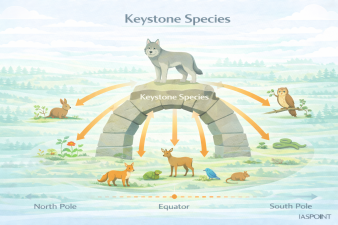
A Keystone Species is an organism that helps hold the entire ecosystem together. Its impact on its community or ecosystem is disproportionately large relative to its abundance or total biomass. If a keystone species is removed, the ecosystem would be dramatically different or cease to exist altogether.
Key Characteristics
- Low Abundance: Unlike “Dominant Species” (which are large in number or biomass), keystone species often exist in small numbers.
- Functional Importance: They perform vital roles such as predation, pollination, or habitat modification.
- Trophic Cascade: Their removal often triggers a “top-down” effect, leading to the collapse of food webs and loss of biodiversity.
Categories and Examples of Keystone Species
Keystone species are categorized based on the specific ecological role they perform within their habitat.
| Category | Role | Primary Example | Impact of Removal |
| Keystone Predators | Control the population of lower trophic levels. | Sea Otters | Sea urchin populations explode, destroying kelp forests. |
| Ecosystem Engineers | Create, modify, or maintain habitats. | Beavers | Loss of wetlands and associated aquatic biodiversity. |
| Keystone Mutualists | Provide essential services like pollination or seed dispersal. | Honey Bees | Collapse of plant reproduction and dependent herbivores. |
| Keystone Prey | Serve as a critical food source for numerous predators. | Antarctic Krill | Starvation of whales, seals, and penguins. |
Detailed Case Studies
1. Sea Otters in Kelp Forests
Sea otters prey on sea urchins. Without otters, sea urchins graze uncontrollably on the holdfasts of kelp (giant seaweed). This turns a lush, carbon-sequestering kelp forest into an “urchin barren,” devoid of fish and other marine life.
2. The African Elephant (Engineer)
Elephants knock down trees and pull up shrubs, which prevents savannas from turning into woodlands. This maintains the grassland ecosystem necessary for grazing animals like zebras and antelopes. They also dig water holes in dry riverbeds that other animals use.
3. Tigers in Indian Forests
As top predators, tigers keep the population of herbivores (like Chital and Sambar) in check. Overpopulation of herbivores would lead to overgrazing, destroying the forest undergrowth and preventing the regeneration of trees.
4. Fig Trees (Keystone Mutualist)
In many tropical forests, fig trees produce fruit throughout the year. During seasons when other fruits are scarce, figs become the sole food source for a wide variety of birds and mammals, ensuring their survival.
Difference Between Keystone and Foundation Species
| Feature | Keystone Species | Foundation Species |
| Abundance | Low abundance/biomass. | High abundance/biomass. |
| Role | Influences through functional activity (e.g., predation). | Creates the physical structure of the ecosystem. |
| Example | Wolf, Sea Star, Tiger. | Corals in a reef, Kelp in a forest. |
Keystone Species and Conservation Strategy
In conservation biology, focusing on a keystone species is a cost-effective strategy. By protecting one species, an entire suite of associated species and ecological processes are preserved.
- Flagship Species: Chosen for their public appeal to gather support (e.g., Giant Panda).
- Umbrella Species: Species with large area requirements; protecting them automatically protects many other species (e.g., Tiger).
- Indicator Species: Their presence or absence reflects the health of the environment (e.g., Lichens for air quality).
UPSC Prelims Trivia: The Starfish Experiment
The concept was popularized by ecologist Robert Paine in 1966. He removed the starfish Pisaster ochraceus from a rocky intertidal zone. In its absence, a single species of mussel took over the entire area, crowding out all other species and reducing the total biodiversity of the site by half. This proved that the predator was the “keystone” keeping the community diverse.
Last Modified: April 18, 2026