

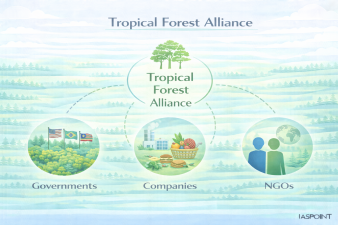
The Tropical Forest Alliance (TFA) is a global public-private partnership dedicated to reducing the tropical deforestation associated with the production of agricultural commodities. It serves as a neutral platform for collaboration among governments, the private sector, and civil society to implement “deforestation-free” supply chains.
Origins and Institutional Framework
- Establishment: Launched at Rio+20 (2012) following a joint commitment by the United States and The Consumer Goods Forum (CGF).
- Original Mandate: Known initially as TFA 2020, it aimed to reduce tropical deforestation related to key commodities by the year 2020. It has since evolved into a long-term alliance.
- Hosting: The TFA Secretariat is hosted by the World Economic Forum (WEF) in Geneva, Switzerland.
- Nature of Alliance: It is a voluntary, non-legally binding platform. It does not provide direct project funding but facilitates policy dialogue and market-based solutions.
Focus Commodities and Regions
The TFA focuses on the “Big Four” commodities which are responsible for the majority of commodity-driven tropical deforestation globally:
- Palm Oil: Major focus in Southeast Asia (Indonesia, Malaysia).
- Soy: Primary driver in the Amazon and Cerrado biomes of South America.
- Beef: Significant impact in Latin America (Brazil, Paraguay).
- Pulp and Paper: Key issue in both Southeast Asia and Africa.
Geographic Priority Areas:
- Southeast Asia (Indonesia, Malaysia, Vietnam).
- Central and West Africa (Congo Basin, Ghana, Côte d’Ivoire).
- South America (Brazil, Colombia, Peru).
Membership and Stakeholders
The TFA brings together over 180 partners across three main categories:
- Governments: Includes producer countries (e.g., Indonesia, Colombia) and consumer/donor countries (e.g., USA, UK, Norway, Netherlands).
- Private Sector: Retailers and manufacturers like Unilever, Walmart, and Nestlé, alongside major commodity traders.
- Civil Society: International NGOs such as Conservation International, Rainforest Alliance, WWF, and World Resources Institute (WRI).
Core Objectives and Strategies
- Supply Chain Transparency: Promoting traceability and monitoring tools (like Global Forest Watch) to ensure commodities are not sourced from deforested land.
- Jurisdictional Approaches: Working with sub-national governments (provinces/states) to ensure that entire landscapes are managed sustainably, rather than just individual farms.
- Smallholder Inclusion: Ensuring that small-scale farmers are not excluded from international markets as “deforestation-free” standards become more stringent.
- Policy Alignment: Harmonizing trade policies (like the EU Deforestation Regulation – EUDR) with the production realities in tropical nations.
Recent Developments and Innovations (2024–2026)
- The Forest Future Alliance (FFA): Launched at the World Economic Forum Annual Meeting in January 2026, this initiative builds on TFA’s legacy to mobilize private capital and philanthropy for large-scale forest stewardship.
- Tropical Forest Forever Facility (TFFF): TFA has been a key platform for discussing the TFFF (an initiative spearheaded by Brazil at COP28 and COP30). The TFFF aims to pay a fixed price per hectare of conserved tropical forest, shifting from carbon-based incentives to “forest-standing” incentives.
- EUDR Compliance: A major focus in 2025-2026 has been assisting producer members in Indonesia and Brazil to align their national traceability systems with the European Union Deforestation Regulation (EUDR).
Comparison: TFA vs. Other Global Initiatives
| Feature | Tropical Forest Alliance (TFA) | REDD+ (UNFCCC) |
| Primary Driver | Commodity Supply Chains (Market-based) | Carbon Sequestration (Climate-based) |
| Governance | Hosted by World Economic Forum | Under the UNFCCC Framework |
| Mechanism | Public-Private Partnership | Result-based Payments for Carbon |
| Focus | Tropical Agricultural Commodities | All Forest-based Emissions |
Important Facts for UPSC Prelims
- Consumer Goods Forum (CGF): The TFA was the primary vehicle to achieve the CGF’s goal of “Zero Net Deforestation.”
- New York Declaration on Forests (NYDF): TFA is a key partner in implementing the goals of the NYDF, which aims to end natural forest loss by 2030.
- 1t.org: The TFA works closely with the WEF’s “Trillion Trees” initiative (1t.org) to ensure that reforestation efforts do not come at the expense of existing primary tropical forests.
- Funding: The TFA itself is funded by donor governments (primarily Norway, UK, and Netherlands) and the WEF; it acts as a “matchmaker” for finance rather than a direct donor.