

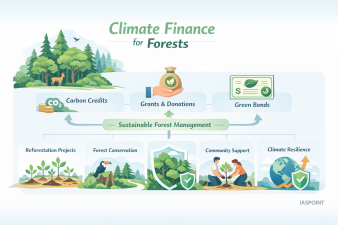
Climate Finance for Forests refers to the local, national, or transnational financing—drawn from public, private, and alternative sources—that seeks to support forest-based climate change mitigation and adaptation.
The Global Architecture: Multi-Lateral and Private Flows
Global forest finance is transitioning from pure grants to performance-based payments and market-driven “High Integrity” carbon credits.
The LEAF Coalition (Lowering Emissions by Accelerating Forest finance)
The LEAF Coalition is a massive public-private voluntary initiative aimed at mobilizing at least $1 billion for jurisdictional REDD+ programs.
- Structure: A coalition of over 30 global companies and the governments of the UK, US, Norway, and South Korea.
- Mechanism: It purchases “high-integrity” carbon credits from national or subnational governments that successfully reduce deforestation.
- Recent Fact: In January 2026, Nepal became the first Asian country to sign a deal with LEAF, expecting up to $55 million for its community-led forest conservation.
Article 6 of the Paris Agreement
Article 6 provides the “rulebook” for international carbon markets, which is fundamental for forest finance.
- Article 6.2: Allows countries to trade emission reductions (ITMOs – Internationally Transferred Mitigation Outcomes) through bilateral agreements.
- Article 6.4: Establishes a new UN-centralized carbon market, replacing the Clean Development Mechanism (CDM). Forests are a primary asset class under this mechanism for “Carbon Removals.”
India’s Domestic Climate Finance for Forests
India has integrated forest financing into its core fiscal strategy through “Green Growth” initiatives.
Sovereign Green Bonds (SGrBs)
The Government of India regularly issues Sovereign Green Bonds to fund green infrastructure, with a portion of the proceeds allocated specifically to the Ministry of Environment, Forest and Climate Change (MoEFCC).
- Utilization: Used for afforestation, biodiversity conservation, and the National Mission for a Green India.
- Investor Security: These bonds offer a sovereign guarantee, making them attractive for domestic institutional investors like insurance companies and banks.
India’s Updated NDC (2031-2035)
In March 2026, the Union Cabinet approved India’s next round of NDCs, raising the bar for forest-based carbon sinks.
- Carbon Sink Goal: India now aims to create an additional carbon sink of 3.5 to 4.0 billion tonnes of CO2 equivalent through forest and tree cover by 2035 (enhanced from the previous 2.5–3 billion target).
- Funding Requirement: Meeting this target requires an estimated annual investment of over ₹50,000 crore, necessitating blended finance (combining public grants with private loans).
Key Global Reports and Imbalances (2026)
| Report | Key Finding |
| State of Finance for Nature (2026) | Highlights a “1:30” imbalance: For every $1 spent on nature protection, $30 is spent on activities that destroy it (e.g., fossil fuel and chemical fertilizer subsidies). |
| UNEP Transition X-Curve | Proposes a strategy to phase out “Nature-Negative” financial flows while rapidly scaling “Nature-Positive” markets. |
Specific Forest-Climate Funds
For Prelims, it is essential to distinguish between the various funds hosted by the Global Environment Facility (GEF) and the World Bank:
- BioCarbon Fund Initiative for Sustainable Forest Landscapes (ISFL): A multilateral fund that promotes reducing greenhouse gas emissions from the land sector, from deforestation to agriculture.
- Forest Carbon Partnership Facility (FCPF): A global partnership of governments, businesses, and indigenous peoples focused on REDD+.
- Adaptation Fund: Financed by a 2% share of proceeds from the CDM/Article 6.4 activities; it funds concrete adaptation projects like coastal mangrove restoration.
Trivia for UPSC Prelims
- Corresponding Adjustments: A concept under Article 6 to prevent “double counting” of carbon credits (if India sells a forest credit to a company in Singapore, India cannot count that same reduction toward its own NDC).
- Jurisdictional REDD+: Unlike small-scale projects, this approach accounts for forest conservation across an entire state or country, reducing the risk of “leakage” (where trees are protected in one patch but cut in the next).
- NIFTY India Sovereign Green Bond Index: Launched by the NSE to track the performance of India’s green debt, providing a benchmark for the “Green Growth” economy.