
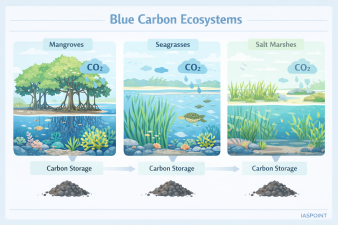
Blue Carbon refers to the carbon captured and stored by the world’s oceanic and coastal ecosystems. While terrestrial forests (Green Carbon) are well-known carbon sinks, coastal ecosystems such as mangroves, seagrasses, and tidal salt marshes are far more efficient at sequestering carbon per unit area. These ecosystems are now a cornerstone of global Nature-based Solutions (NbS) for climate change mitigation.
Primary Blue Carbon Sinks
Blue carbon ecosystems are unique because they store the majority of their carbon in anoxic (oxygen-poor) soils, where decomposition is extremely slow.
| Ecosystem | Habitat Description | Carbon Storage Mechanism |
| Mangroves | Tropical and subtropical intertidal zones. | High biomass and deep organic sediment layers. |
| Seagrasses | Submerged flowering plants in shallow coastal waters. | Trap fine sediments and organic matter in dense root mats. |
| Salt Marshes | Coastal wetlands flooded and drained by salt water. | Accumulate organic matter in soil that can be several meters deep. |
| Kelp Forests | Large brown algae (emerging as “Broad-sense” Blue Carbon). | Rapid growth; carbon is sequestered when kelp detritus sinks to the deep ocean. |
Comparative Carbon Dynamics: Blue vs. Green Carbon
Understanding the distinction between different “colors” of carbon is a frequent UPSC Prelims requirement.
- Blue Carbon: Sequestered in marine/coastal systems. Storage is primarily in sediments (up to 90%), where it can remain for millennia if undisturbed.
- Green Carbon: Sequestered in terrestrial ecosystems (forests, grasslands). Storage is primarily in above-ground biomass (trunks, leaves).
- Sequestration Efficiency: Blue carbon ecosystems can sequester carbon at rates 2 to 10 times higher than mature tropical forests.
- Emissions Threat: When degraded, blue carbon sinks release massive amounts of CO2. It is estimated that 3-7% of global GHG emissions from land-use change come from the destruction of these coastal habitats.
India’s Blue Carbon Profile and Initiatives (2025–2026)
India has intensified its focus on Blue Carbon as part of its goal to create an additional carbon sink of 2.5 to 3 billion tonnes of CO2 equivalent by 2030.
Key National Frameworks
- MISHTI Scheme (2023-2026): The “Mangrove Initiative for Shoreline Habitats & Tangible Incomes” aims to restore 540 sq. km of mangroves across 11 States and 2 UTs.
- Blue Flag Certification: As of the 2025-26 season, India has secured Blue Flag certification for 18 beaches, emphasizing sustainable management of coastal ecosystems.
- Ramsar Sites Expansion: India reached 98 Ramsar Sites by January 2026 (the highest in Asia), many of which are vital blue carbon salt marshes and mangroves like the Sundarbans and Chilika Lake.
- Draft Blue Economy Policy: Focuses on “Marine Spatial Planning” to balance economic activity with the preservation of carbon-rich coastal zones.
Global Governance and Market Trends
The period of 2024–2026 has seen a shift toward the financialization of blue carbon.
- Blue Carbon Markets: The global market for blue carbon credits is projected to reach $1.2 Billion in 2026. India is identified as a high-growth region (27.5% CAGR) for corporate net-zero investments in the Sundarbans and Gulf of Kachchh.
- International Partnership for Blue Carbon (IPBC): India collaborates with this forum (coordinated by Australia and IOC-UNESCO) to standardize carbon accounting.
- UN Decade on Ecosystem Restoration (2021–2030): Places coastal “Blue” habitats at the forefront of the global restoration agenda.
Fact Sheet for UPSC Prelims
- Global Distribution: Indonesia holds the largest share (~23%) of global mangroves. India holds approximately 3% of South Asia’s cover.
- Anoxic Sediments: The lack of oxygen in coastal soils prevents bacteria from breaking down organic matter, allowing carbon to be buried for thousands of years.
- Ecosystem Services: Beyond carbon, these sites provide “Bio-shields” against tsunamis, nursery grounds for 80% of global fish catches, and water filtration.
- Threats: The primary drivers of blue carbon loss are aquaculture (shrimp farming), coastal urban development, and sea-level rise “squeezing” habitats against sea walls.