

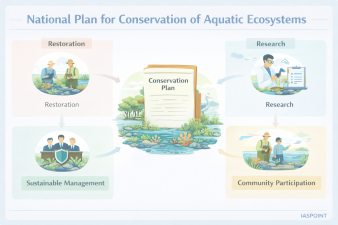
The National Plan for Conservation of Aquatic Ecosystems (NPCA) is a single, integrated scheme for the conservation of both lakes and wetlands in India. It was formulated by merging two erstwhile schemes: the National Lake Conservation Plan (NLCP) and the National Wetlands Conservation Programme (NWCP).
Origin and Institutional Mechanism
The NPCA was brought under a unified framework to promote a holistic approach to the management of aquatic ecosystems, acknowledging that lakes and wetlands often share similar ecological challenges.
- Implementation Agency: The scheme is implemented by the Ministry of Environment, Forest and Climate Change (MoEFCC).
- Funding Pattern: The funding is shared between the Central Government and the respective State Governments. For most states, the ratio is 60:40; for North-Eastern and Himalayan states, it is 90:10.
- Operational Goal: To provide financial assistance to State Governments for the implementation of integrated management plans for identified water bodies.
Core Objectives of NPCA
The plan focuses on the restoration of water quality and the preservation of biodiversity through “Integrated Management Plans.”
- Holistic Conservation: To stop further degradation of wetlands and lakes and to restore their ecological health.
- Water Quality Improvement: Maintaining the chemical, physical, and biological integrity of water through pollution abatement.
- Biodiversity Protection: Conserving endemic and migratory species by protecting their habitats.
- Public Awareness: Encouraging community participation and the “Wise Use” principle as advocated by the Ramsar Convention.
Key Interventions and Strategies
The NPCA adopts both “in-situ” and “ex-situ” measures to achieve its goals:
| Type of Measure | Key Activities |
|---|---|
| In-situ (On-site) | De-silting, de-weeding (removal of invasive species like water hyacinth), and bio-remediation. |
| Pollution Abatement | Interception, diversion, and treatment of domestic sewage; setting up of decentralized STPs. |
| Catchment Area Treatment | Afforestation, soil conservation, and storm-water management to prevent siltation. |
| Boundary Demarcation | Use of GIS and satellite imagery to map wetland boundaries and prevent encroachment. |
Regulatory and Support Framework
The NPCA works in tandem with existing environmental laws to provide a multi-layered defense for aquatic bodies.
Integration with Wetland Rules
While the Wetlands (Conservation and Management) Rules, 2017 provide the legal regulatory framework (prohibitions and permissions), the NPCA acts as the financial and technical vehicle to carry out the actual conservation work.
Mission Sahbhagita
A recent sub-component under NPCA that emphasizes a “whole-of-society” approach. It aims to develop a network of Wetland Mitras (local volunteers) to monitor water bodies and report violations like dumping or encroachment.
Distinction for Prelims: Wetlands vs. Lakes
Under NPCA, the distinction is based on depth and usage, though they are managed under one plan:
- Wetlands: Usually shallower water bodies (less than 6m at low tide) characterized by specific vegetation (hydrophytes) and hydric soils.
- Lakes: Generally deeper water bodies with less emergent vegetation, often used for drinking water or recreation.
Facts and Trivia for Quick Revision
- Scope: NPCA covers only those water bodies that are identified by the State Governments and approved by the MoEFCC based on ecological significance.
- NPCA and Ramsar: While all Ramsar sites are eligible for support under NPCA, not all water bodies under NPCA are Ramsar sites.
- Amrit Dharohar Integration: Since 2023, NPCA has been aligned with the Amrit Dharohar initiative to specifically enhance the “Wise Use” of Ramsar sites over a three-year period.
- Climate Change Linkage: NPCA is increasingly being used as a tool for Climate Change Adaptation, focusing on wetlands as carbon sinks and natural flood buffers.