
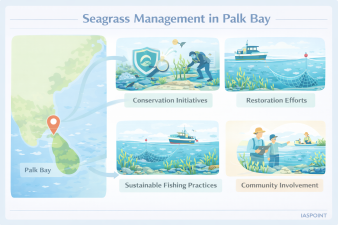
Palk Bay, situated between the southeast coast of India (Tamil Nadu) and northern Sri Lanka, is home to one of the most extensive and diverse seagrass meadows in the world. Unlike seaweed (which are algae), seagrasses are flowering plants (angiosperms) that grow submerged in shallow marine environments.
- Diversity: Out of the 14 species of seagrasses found in India, 11 species are recorded in Palk Bay, including Enhalus acoroides and Thalassia hemprichii.
- Significance: This region acts as a major “Blue Carbon” sink and a critical nursery ground for commercially important fish, crabs, and shrimps.
Ecological Importance of Seagrasses
Seagrasses are often referred to as the “lungs of the sea” due to their high oxygen production and nutrient cycling capabilities.
- Dugong Habitat: Palk Bay is the primary habitat for the Dugong (Sea Cow), an herbivorous marine mammal listed as ‘Vulnerable’ on the IUCN Red List and protected under Schedule I of the Wildlife (Protection) Act, 1972.
- Carbon Sequestration: Seagrass meadows can capture and store carbon in the soil up to 40 times faster than terrestrial forests.
- Coastal Protection: Their root systems stabilize the seabed, preventing coastal erosion and trapping sediments to improve water clarity.
The Dugong Conservation Reserve
In 2022, the Tamil Nadu government notified India’s first Dugong Conservation Reserve in Palk Bay, covering the coastal waters of Thanjavur and Pudukkottai districts.
| Feature | Details |
| Area | Approximately 448 square kilometers. |
| Objective | To protect the seagrass beds which are the sole food source for Dugongs. |
| Legal Status | Notified under the Wildlife (Protection) Act, 1972. |
| Management | Involves community-based conservation with local fishing (Kadalkanni) groups. |
Major Threats to Seagrass in Palk Bay
The degradation of seagrass in this region is primarily driven by destructive fishing practices and environmental changes.
- Bottom Trawling: The most significant threat; heavy nets dragged along the seafloor physically uproot seagrass and destroy the habitat.
- Sedimentation: Runoff from rivers increases turbidity, blocking the sunlight required for seagrass photosynthesis.
- Eutrophication: Excessive nutrient discharge from agricultural runoff leads to algal blooms that shade and “smother” the seagrass beds.
- Anchor Damage: Mechanical scarring from boat anchors and propellers in shallow waters.
Current Management and Restoration Strategies (2025-2026)
Management has shifted from purely regulatory measures to active scientific restoration.
Seagrass Restoration (Transplantation)
- Technique: Use of the “Plug and Frame” method where healthy seagrass sods are transplanted into degraded areas using biodegradable frames.
- Artificial Reefs: Deployment of concrete structures to prevent bottom trawling and provide a substrate for marine life, indirectly protecting adjacent seagrass beds.
Community Participation: “Sea Cow Mitras”
- Following the success of “Wetland Mitras,” local fishers are being trained as “Sea Cow Mitras” to report Dugong sightings and prevent illegal poaching or accidental entanglement in nets (by-catch).
Integrated Coastal Zone Management (ICZM)
- Seagrass monitoring is now integrated into the ICZM plan for Tamil Nadu, utilizing satellite imagery and underwater drones (ROVs) for real-time health assessment of the meadows.
Facts for Prelims Trivia
- Flowering in the Sea: Seagrasses are the only marine plants that complete their entire life cycle—including pollination and seed production—completely submerged in salt water.
- Dugong Fact: A single adult Dugong can consume up to 40 kg of seagrass in a single day.
- Location: Palk Bay is distinct from the Gulf of Mannar; while both have seagrass, Palk Bay’s meadows are generally more continuous and shallower.
- International Link: Since Palk Bay is shared, India and Sri Lanka are collaborating under the SAARC framework for the transboundary protection of Dugongs and their habitats.