
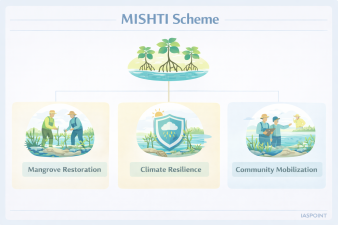
The Mangrove Initiative for Shoreline Habitats & Tangible Incomes (MISHTI) is a flagship scheme of the Government of India aimed at the comprehensive restoration of mangrove ecosystems. Launched on World Environment Day (June 5, 2023), the scheme bridges the gap between environmental conservation and socio-economic upliftment for coastal communities.
Objective and Scope of MISHTI
The primary goal is to increase mangrove cover along the Indian coastline and on salt pan lands through scientific afforestation and reforestation.
- Target: Restoration of approximately 540 sq. km of mangroves across India.
- Duration: Planned for a five-year period from 2023 to 2028.
- Geographical Reach: Covers 11 Coastal States and 2 Union Territories, with a primary focus on the East Coast (Sundarbans, Mahanadi, Krishna-Godavari) and the West Coast (Gulf of Kutch, Konkan).
- Global Alignment: Contributes to the Mangrove Alliance for Climate (MAC), an intergovernmental initiative launched at COP27 (Egypt) which India joined as an active member.
Implementation and Funding Mechanism
The scheme operates on a Convergence Model, integrating resources from multiple existing central and state programs to ensure financial sustainability.
| Funding Source / Partner | Role in MISHTI |
| CAMPA Fund | The primary funding vehicle (approx. 70%); provides grants for afforestation and nursery development. |
| MGNREGS | Provides the labor component (waged employment) for plantation and maintenance activities. |
| National Coastal Mission | Provides technical guidelines and integration with broader coastal management goals. |
| Private Sector/CSR | Encourages corporate participation in mangrove conservation through Corporate Social Responsibility. |
Core and Support Activities
MISHTI is designed as a “whole-of-ecosystem” approach rather than just a plantation drive.
Core Conservation Activities
- Nursery Raising: Developing local nurseries for site-specific mangrove species like Rhizophora and Avicennia.
- Site Preparation: Channel excavation and seed dibbling in mudflats and abandoned aquaculture ponds.
- Invasive Species Removal: Rehabilitation of areas infested with alien species to restore native biodiversity.
Tangible Income & Support Activities
- Sustainable Livelihoods: Promoting “Mangrove Honey” production, backyard duckery, and sustainable fisheries.
- Eco-Tourism: Recent amendments to the Van (Sanrakshan Evam Samvardhan) Adhiniyam, 1980 now categorize eco-tourism as a forestry activity, allowing it to be integrated into MISHTI.
- Carbon Credits: The scheme aims to sequester an estimated 4.5 million tonnes of carbon, potentially opening avenues for carbon credit markets.
Current Status and Leadership (2026 Update)
As of early 2026, the scheme has moved from the preparatory phase to active large-scale restoration.
- Gujarat’s Leadership: Gujarat has emerged as the top performer, accounting for nearly 85% of the total land area (over 19,000 hectares) taken up for restoration under the scheme so far.
- National Level Workshops: Recent summits in early 2026 (e.g., in Vijayawada) have focused on standardizing scientific methods for mangrove restoration across all coastal states.
- Technological Integration: Use of drones and satellite imagery is being utilized to track the survival rates of saplings in difficult-to-access swampy terrains.
Facts for Prelims Trivia
- India’s Mangrove Cover: According to the latest official data (ISFR 2021/2023), India has 4,992 sq. km of mangrove cover (~0.15% of total land area).
- States with Most Cover: West Bengal (Sundarbans) is 1st, followed by Gujarat and the Andaman & Nicobar Islands.
- Blue Carbon: Mangroves are significantly more efficient at carbon sequestration than terrestrial forests, storing most of the carbon in their soil/sediment rather than just biomass.
- Pneumatophores: These are “breathing roots” essential for mangroves to survive in anaerobic, water-logged saline soils.