

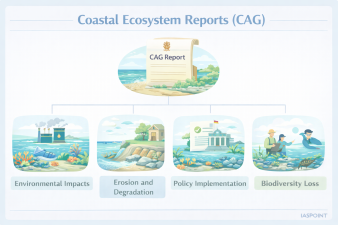
The Comptroller and Auditor General (CAG) of India tabled a significant performance audit report (Report No. 4 of 2022) titled “Conservation of Coastal Ecosystems” in Parliament. This audit evaluated the effectiveness of the Ministry of Environment, Forest and Climate Change (MoEFCC) in protecting coastal ecology between 2015 and 2020, with updates continuing to influence policy in 2026.
Institutional Deficiencies
The CAG highlighted structural gaps in the bodies responsible for enforcing the Coastal Regulation Zone (CRZ) notifications.
- Ad-hoc Status of NCZMA: The National Coastal Zone Management Authority (NCZMA) was not notified as a permanent body. It functioned as an ad-hoc entity, reconstituted periodically, which hindered long-term consistent policy implementation.
- State-Level Gaps (SCZMAs): Many states faced delays in reconstituting State Coastal Zone Management Authorities. For instance, Karnataka had not reconstituted its SCZMA for long periods, while Goa, Odisha, and West Bengal saw significant delays.
- District Level Committees (DLCs): In Andhra Pradesh, DLCs (responsible for grassroot monitoring) were not even established during the audit period. In Tamil Nadu, DLCs lacked participation from local traditional fishing communities, which is a mandatory requirement.
Procedural Lapses in Project Clearances
The audit found that the process of granting environmental clearances was often diluted or bypassed.
- Flawed EIA Reports: Clearances were granted despite major inadequacies in Environment Impact Assessment (EIA) reports. Issues included:
- Use of outdated and non-site-specific data.
- EIAs prepared by non-accredited consultants.
- Failure to evaluate the cumulative impact of multiple projects in fragile zones.
- EAC Dilution: The Expert Appraisal Committees (EAC) sometimes deliberated on projects with less than half of their required member strength.
- Post-Clearance Monitoring: There was a systemic failure in monitoring whether project proponents complied with the conditions set during the grant of clearance.
Regional Conservation Failures (State-Specific)
The CAG identified specific instances where coastal biodiversity was at high risk due to administrative negligence.
| State | CAG Observation / Finding |
| Tamil Nadu | Lack of a specific strategy to conserve the Gulf of Mannar Islands. |
| Goa | Absence of a dedicated system for monitoring Coral Reefs and lack of management plans for Turtle nesting sites. |
| Gujarat | Scientific instruments purchased for studying the Gulf of Kutch remained unutilized. |
| Odisha | Lack of sea patrolling in the Gahirmatha Sanctuary, critical for Olive Ridley protection. |
| Andhra Pradesh | Disposal of aquaculture waste into the Coringa Wildlife Sanctuary. |
Environmental Violations and SDG 14
The report emphasized that irregular activities were directly threatening India’s progress toward Sustainable Development Goal 14 (Life Below Water).
- Illegal Construction: Using satellite imagery, the CAG identified illegal resorts and jetties built within CRZ-IA (Ecologically Sensitive Areas) in Tamil Nadu and Gujarat.
- Effluent Discharge: Large-scale discharge of untreated municipal sewage and industrial waste was observed in the coastal waters of Karnataka and Maharashtra.
- Plastic Debris: The CAG noted that the Ministry of Earth Sciences had yet to prepare a robust indicator for “plastic debris density,” essential for assessing marine health.
Key Recommendations for 2026 Policy
To address these findings, the CAG proposed several corrective measures that have since been integrated into the Mission Sahbhagita and the National Coastal Mission.
- Permanent NCZMA: Transitioning the NCZMA from an ad-hoc body to a permanent statutory authority for better accountability.
- GIS Integration: Creating expert cells at the district level (DLCs) equipped with GIS and Remote Sensing tools to track real-time changes in the coastline and detect encroachments.
- Database for Biodiversity: Establishing a comprehensive national database on coastal biodiversity, including corals, seagrasses, and mangroves, to facilitate evidence-based conservation.
- Strict Penalty Mechanism: Strengthening the enforcement mechanism to ensure that violations of CRZ norms lead to immediate and deterrent penalties.