

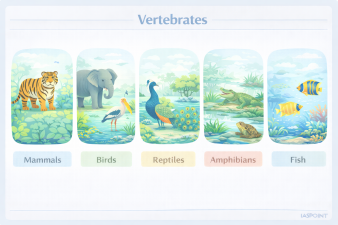
Vertebrates are members of the subphylum Vertebrata, characterized by the presence of a backbone or spinal column.
Pisces: Fish Diversity in India
India possesses a rich aquatic faunal diversity, supported by its extensive coastline and perennial river systems.
- Diversity: India accounts for nearly 11% of the world’s fish species.
- Freshwater vs. Marine: Over 3,100 species are recorded, with significant endemism in the Western Ghats and the Northeast.
- Key Species:
- Ganges River Dolphin: Though a mammal, it shares the habitat of the Gharial and Gangetic Shark (one of the few freshwater sharks globally).
- Mahseer: Known as the “Tiger of the Water.” The Hump-backed Mahseer is Critically Endangered and found in the Kaveri river basin.
- Whale Shark: The world’s largest fish; migrates to the Gujarat coast. It is protected under Schedule I of the WPA.
Amphibians: Indicators of Ecosystem Health
Amphibians are ectothermic vertebrates that require both aquatic and terrestrial environments to complete their life cycle.
- Endemism: Approximately 80% of amphibians in the Western Ghats are endemic.
- Purple Frog (Nasikabatrachus sahyadrensis): A “living fossil” found in the Western Ghats that spends most of its life underground.
- Threats: Highly susceptible to Chytrid fungus, habitat fragmentation, and climate change.
Reptiles: The Scaled Fauna
India’s reptilian diversity includes crocodiles, turtles, lizards, and snakes.
| Group | Key Species | Conservation Status/Fact |
| Crocodilians | Gharial, Mugger, Saltwater Crocodile | Bhitarkanika (Odisha) has the highest density of Saltwater Crocodiles. |
| Turtles | Olive Ridley, Batagur baska | Gahirmatha (Odisha) is the world’s largest arribada (mass nesting) site. |
| Snakes | King Cobra, Indian Rock Python | The King Cobra is the only snake in the world that builds a nest. |
| Lizards | Monitor Lizard | All four species found in India are protected under Schedule I of WPA. |
Aves: Avian Diversity and Flyways
India acts as a major hub for migratory birds, primarily via the Central Asian Flyway (CAF).
- Vultures: India hosts 9 species. The population crash in the 1990s was linked to Diclofenac (a veterinary NSAID). The Vulture Conservation Breeding Centres (VCBC) were established to counter this.
- Great Indian Bustard (GIB): State bird of Rajasthan; Critically Endangered. It is a flagship species of the grassland ecosystem.
- Amur Falcon: Known for one of the longest migrations; Nagaland is recognized as the “Falcon Capital of the World.”
- Steppe Eagle: A common migratory raptor found in the Tal Chhapar and Desert National Park regions.
Mammals: High-Profile Conservation Targets
Mammals are endothermic (warm-blooded) vertebrates with mammary glands. They often serve as Umbrella Species for conservation.
Marine Mammals
- Dugong (Sea Cow): An herbivorous marine mammal found in the Gulf of Mannar, Palk Bay, and Andaman and Nicobar Islands.
- Irrawaddy Dolphin: Found in Chilika Lake; characterized by a bulging forehead and no beak.
Terrestrial Mammals and Specialist Habitats
- Asiatic Lion: Restricted to Gir National Park (Gujarat).
- One-Horned Rhinoceros: Found primarily in Kaziranga (Assam) and Jaldapara (West Bengal).
- Nilgiri Tahr: Found in the Eravikulam National Park; prefers montane grasslands (Sholas).
- Himalayan Musk Deer: Hunted for ‘musk’ used in perfumes; found in high-altitude sub-alpine forests.
Key Comparative Facts for Prelims
- Cold-Blooded (Ectothermic): Pisces, Amphibians, and Reptiles. Their internal temperature varies with the environment.
- Warm-Blooded (Endothermic): Aves and Mammals. They maintain a constant body temperature.
- Heart Chambers: * Two-chambered: Fish.
- Three-chambered: Amphibians and Reptiles (except Crocodiles, which have four).
- Four-chambered: Aves and Mammals.
- Egg Laying (Oviparous) vs. Live Birth (Viviparous): Most vertebrates lay eggs, but most mammals give birth to live young (Exceptions: Monotremes like the Platypus and Echidna, which lay eggs).
Important Conservation Laws for Vertebrates
The Wildlife Protection Act, 1972 was significantly amended in 2022 to align with CITES (Convention on International Trade in Endangered Species of Wild Fauna and Flora).
- Schedule I: Includes the Tiger, Elephant, Lion, GIB, and Gangetic Dolphin.
- Schedule II: Includes various species of macaques and civets.
- CITES Appendices: Now integrated into the WPA schedules to regulate international trade of endangered vertebrates.