
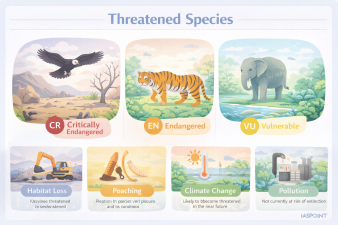
Threatened Species is a technical umbrella term encompassing three IUCN categories: Critically Endangered (CR), Endangered (EN), and Vulnerable (VU). India, as a mega-biodiverse nation, currently hosts over 100 species in these high-risk categories. For 2026 aspirants, focus remains on species impacted by infrastructure (GIB), climate change (Snow Leopard), and invasive species (Lantana camara’s impact on Tiger prey).
Critically Endangered (CR) Fauna in India
Species in this category face an extremely high risk of extinction in the wild.
| Species Group | Species Name | Key Facts for Prelims |
| Birds | Great Indian Bustard | Heaviest flying bird; flagship of grasslands; threatened by power lines in Rajasthan/Gujarat. |
| Birds | Bengal Florican | Found in Terai grasslands (Manas NP); known for its spectacular jumping courtship display. |
| Mammals | Pygmy Hog | Smallest and rarest wild pig; endemic to Manas National Park, Assam. |
| Mammals | Namdapha Flying Squirrel | Endemic to a single valley in Namdapha NP, Arunachal Pradesh; nocturnal. |
| Mammals | Malabar Civet | Endemic to Western Ghats; sightings are extremely rare. |
| Reptiles | Gharial | Fish-eating crocodile; major population in Chambal River; has a distinct ‘ghara’ on snout. |
| Reptiles | Red-crowned Roofed Turtle | Found in the Ganga-Chambal basin; males display striking colors during breeding. |
| Fish | Ganges Shark | One of the world’s few freshwater sharks; often confused with the Bull Shark. |
Endangered (EN) Fauna: High-Profile Conservation Icons
Endangered species have a very high risk of extinction. Many are the subject of specific “Project” based conservation.
- Asiatic Lion: Restricted solely to the Gir landscape in Gujarat. Census 2025 showed a population recovery to ~891.
- Royal Bengal Tiger: Found across 18 tiger states; habitat loss and Lantana camara (invasive weed) are current major threats.
- Sangai (Eld’s Deer): The “dancing deer” of Manipur; found only on the floating phumdis of Keibul Lamjao National Park.
- Gangetic River Dolphin: India’s National Aquatic Animal; blind, uses echolocation; found in the Ganga-Brahmaputra-Meghna systems.
- Indian Pangolin: World’s most trafficked mammal; poached for scales used in traditional medicine.
Vulnerable (VU) Species: The Success Stories and Warning Signs
Species that move from EN to VU are often cited as conservation successes.
- Indian One-horned Rhino: Concentrated in Kaziranga, Manas, and Jaldapara. Population recovery has moved it from EN to VU.
- Snow Leopard: Found in the high-altitude Himalayas (Hemis NP). Known as the “Ghost of the Mountains.”
- Dugong (Sea Cow): An herbivorous marine mammal. India established its first Dugong Conservation Reserve in Palk Bay (Tamil Nadu) in 2025.
- Olive Ridley Turtle: Famous for Arribada (mass nesting) on Odisha coasts (Gahirmatha and Rushikulya).
Critical Flora: Threatened Plants of India
The Botanical Survey of India (BSI) highlights several plant species that are critically rare.
- Berberis nilghiriensis: A critically endangered medicinal plant found only in the Nilgiri Hills.
- Actinodaphne lanata (Malabar Laurel): Endemic to the Southern Western Ghats.
- Pterocarpus santalinus (Red Sanders): Endemic to Seshachalam Hills (Andhra Pradesh); often shifts between EN and NT due to high illegal trade.
Threats and Conservation Drivers (2025-2026 Trends)
- Planetary Boundaries: The State of India’s Environment 2026 report highlights that India has breached seven of nine planetary boundaries, accelerating habitat loss.
- Linear Infrastructure: Roads and power lines are now the leading killers of GIB and Asian Elephants (railway collisions).
- Invasive Species: Lantana camara has invaded nearly 50% of India’s scrublands, suppressing native grasses and reducing the prey base for carnivores like Tigers.
- Legal Shift: The Wildlife Protection (Amendment) Act, 2022 integrated CITES provisions, increasing penalties for the trade of threatened species listed in its new schedules.