
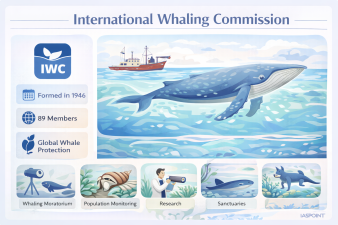
The International Whaling Commission (IWC) is the global intergovernmental body charged with the conservation of whales and the management of whaling. It was established under the International Convention for the Regulation of Whaling (ICRW), signed in Washington, D.C., on December 2, 1946.
Governance and Structure
The IWC operates as a decision-making body that periodically revises the “Schedule,” a legally binding document that outlines specific whaling regulations.
- Headquarters: Impington, near Cambridge, United Kingdom.
- Membership: As of 2026, the IWC comprises 88 member states. Membership is open to any nation that adheres to the ICRW, including non-whaling “conservationist” nations.
- Voting: Major changes to the Schedule (like setting catch limits) require a three-quarters majority of voting members.
- Key Committees: Includes the Scientific Committee (annual meetings), the Conservation Committee, and the Finance and Administration Committee.
The 1986 Moratorium on Commercial Whaling
In 1982, the IWC voted to implement a pause on commercial whaling, which came into full effect in 1986. This is commonly known as the “Commercial Whaling Moratorium.”
- Status in 2026: The moratorium remains in place and applies to all member nations.
- Current Defiance: Despite the ban, Norway and Iceland continue commercial whaling under “objection” or “reservation” clauses within the treaty.
- Japan’s Exit: Japan officially withdrew from the IWC in July 2019. It currently conducts commercial whaling within its own territorial waters and Exclusive Economic Zone (EEZ) but has ceased whaling in the Southern Ocean (Antarctic).
Permitted Categories of Whaling
The IWC recognizes specific exceptions where whaling is permitted despite the global moratorium.
| Category | Description | Examples / Countries |
|---|---|---|
| Aboriginal Subsistence Whaling (ASW) | Conducted by indigenous groups to satisfy nutritional and cultural requirements. It is not for profit. | Inuit (Greenland), Chukotka (Russia), Bequia (St. Vincent & Grenadines), Makah Tribe (USA). |
| Special Permit (Scientific) Whaling | Article VIII of the ICRW allows nations to kill whales for scientific research. | Historically used extensively by Japan; currently largely inactive among members. |
Major Sanctuaries and Conservation Initiatives
The IWC has designated specific areas where all commercial whaling is prohibited, regardless of the moratorium status of species.
- Indian Ocean Whale Sanctuary (1979): Encompasses the entire Indian Ocean south to 55°S.
- Southern Ocean Whale Sanctuary (1994): Surrounds the continent of Antarctica.
- Bycatch Mitigation: The IWC partners with the IMO and FAO to reduce “accidental” whale deaths caused by entanglement in fishing gear and ship strikes.
- Florianópolis Declaration (2018): A landmark non-binding resolution that shifted the IWC’s focus towards the permanent conservation of whales and recognized commercial whaling as an unnecessary economic activity.
Environmental Challenges Addressed by IWC
Beyond hunting, the IWC monitors modern threats to cetaceans:
- Climate Change: Impacting prey availability (krill) and migratory patterns.
- Marine Debris: Plastic ingestion and entanglement.
- Ocean Noise: Anthropogenic noise from shipping and sonar interfering with whale communication (echolocation).
Key Facts for UPSC Prelims
- India’s Standing: India is a member of the IWC and has historically supported the moratorium and conservation-led policies.
- Legal Nature: The ICRW is an “International Convention,” and while its Schedule is binding on members, the Commission lacks a strong international enforcement mechanism (relying on national implementation).
- Whale Sense: The IWC promotes “Whale Watching” as a sustainable economic alternative to whaling, contributing to coastal economies without depleting stocks.
- 2026 Outlook: The 70th Biennial Meeting (IWC70) is scheduled for late 2026 in Hobart, Australia, focusing on the 40th anniversary of the moratorium and the critical status of the North Atlantic Right Whale.