
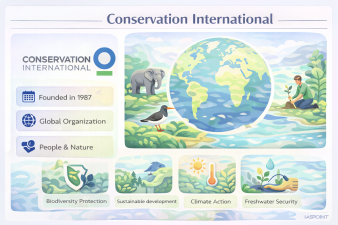
Conservation International (CI) is an American nonprofit environmental organization that aims to protect the nature that humanity relies on for food, fresh water, livelihoods, and a stable climate. Unlike intergovernmental bodies (like UNEP), CI is an NGO that works through science, policy, and partnerships with governments and the private sector.
- Established: 1987.
- Headquarters: Arlington, Virginia, USA.
- Core Philosophy: CI shifted the conservation narrative from “protecting nature for nature’s sake” to “protecting nature for the well-being of people.”
- Accreditation: It is an accredited project agency for the Global Environment Facility (GEF) and the Green Climate Fund (GCF).
The Concept of Biodiversity Hotspots
While British ecologist Norman Myers introduced the “Hotspot” concept in 1988, Conservation International adopted it as its institutional blueprint in 1989 and has since been the primary organization responsible for identifying and reassessing these areas.
Strict Qualification Criteria
To qualify as a Biodiversity Hotspot, a region must meet two rigorous conditions:
- Species Endemism: It must contain at least 1,500 species of vascular plants (> 0.5% of the world’s total) as endemics.
- Degree of Threat: It must have lost at least 70% of its original native vegetation (i.e., it must have 30% or less of its original habitat remaining).
| Metric | Global Data (2026) |
| Total Number of Hotspots | 36 Regions |
| Land Surface Covered | ~2.5% of Earth’s land surface |
| Biodiversity Concentration | Support >50% of world’s plant species and 43% of bird, mammal, reptile, and amphibian species as endemics. |
Biodiversity Hotspots in India
India is home to four major biodiversity hotspots, either partially or fully:
- The Himalayas: Includes the entire Indian Himalayan region (and that falling in Pakistan, Tibet, Nepal, and Bhutan).
- Indo-Burma: Includes the Purvanchal Hills, Arakan Yoma, and Eastern Bangladesh (covers North-East India south of the Brahmaputra).
- The Western Ghats and Sri Lanka: Includes the entire Western Ghats and the island of Sri Lanka.
- Sundaland: Includes the Nicobar Islands (part of a larger hotspot covering Indonesia, Malaysia, and Singapore).
Key Initiatives and Funds
CI manages and partners in several high-impact global funds:
- Critical Ecosystem Partnership Fund (CEPF): A joint initiative of CI, the French Development Agency, the EU, GEF, Government of Japan, and the World Bank. It provides grants to NGOs and civil society to protect hotspots.
- The Blue Nature Alliance: A global partnership to accelerate effective large-scale ocean conservation, aiming to protect 18 million square kilometers of the ocean.
- Arbor Day Foundation Partnership: Massive reforestation projects aimed at carbon sequestration.
2026 Focus: Nature-Based Solutions (NbS)
In 2026, CI’s strategy is heavily aligned with “High-Integrity Carbon Markets” and the Kunming-Montreal Global Biodiversity Framework.
- Tropical Forests Forever Facility (TFFF): CI is a key technical partner in this $125 billion fund (led by Brazil) designed to pay tropical nations for keeping their forests standing.
- Green-Gray Infrastructure: Combining conservation (mangroves/reefs) with conventional engineering to protect coastal communities from climate-induced disasters.
- AI for Nature: Utilizing “TinyML” (Tiny Machine Learning) to monitor wildlife in remote hotspots without needing internet connectivity.
Key Trivia for Prelims
- Vascular Plants Focus: The hotspot criteria specifically use vascular plants as the primary measure because they are well-documented and essential for the survival of other taxa.
- Hottest Hotspots: Out of the 36, some are “Hottest” based on extreme endemism and threat, including the Western Ghats/Sri Lanka and the Indo-Burma region.
- North American Coastal Plain: This was the latest addition (36th) to the global list of hotspots.
- Megadiverse Countries: Do not confuse “Hotspots” with “Megadiverse Countries.” The latter is a group of 17 countries (including India) that harbor the majority of Earth’s species; CI also helped define this category.