

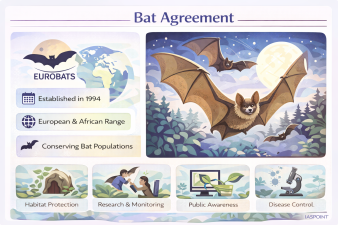
The Agreement on the Conservation of Populations of European Bats, commonly referred to as EUROBATS, is a legally binding international treaty aimed at protecting bat species across Europe, Northern Africa, and the Middle East. Concluded in 1991 under the framework of the Bonn Convention (CMS), it addresses the declining populations of bats due to habitat loss, human disturbance, and the use of toxic pesticides.
Institutional Framework and Legal Status
As a “daughter agreement” of the Convention on the Conservation of Migratory Species of Wild Animals (CMS), EUROBATS provides a platform for transboundary cooperation. While many bats are not long-distance migrators like birds, their foraging and hibernation patterns often span national borders.
| Feature | Details |
| Date of Adoption | December 4, 1991 (London) |
| Entry into Force | January 16, 1994 |
| Legal Basis | Article IV(3) of the CMS (Bonn Convention) |
| Secretariat Location | UN Campus, Bonn, Germany (co-located with CMS) |
| Member States | 39 Parties (out of 63 identified Range States) |
| Main Decision Body | Meeting of the Parties (MOP), held every 3–4 years |
Species and Geographical Scope
The agreement covers all species of bats (Order: Chiroptera) occurring in the Agreement Area. Currently, it pertains to 55 species, primarily from the families Rhinolophidae (Horseshoe bats) and Vespertilionidae (Vesper bats).
Geographical Boundaries
The “Agreement Area” is broader than the political definition of Europe:
- North: Svalbard Archipelago.
- East: Longitude 50° E (covering parts of Western Asia/Russia).
- South: Mediterranean Basin and Northern Africa.
- West: The Azores (30° W).
Fundamental Obligations of Parties
Parties to EUROBATS are required to incorporate bat conservation into their national legislative and administrative frameworks.
Protection and Research
- Prohibition of Killing: Parties must prohibit the deliberate capture, keeping, or killing of bats, except for legitimate scientific research (under permit).
- Site Identification: Identifying and protecting important “roosting sites” used for shelter, breeding, and hibernation.
- Habitat Management: Protecting critical feeding areas and ensuring land-use planning accounts for bat biodiversity.
- Pesticide Regulation: Promoting the replacement of highly toxic timber treatment chemicals and pesticides with safer alternatives to prevent secondary poisoning of bats.
Public Awareness and Monitoring
- Education: Raising public awareness about the ecological benefits of bats (e.g., pest control).
- International Monitoring: Coordinating pan-European studies to track population trends and migratory routes to identify “bottleneck” areas.
UPSC Prelims: Essential Facts and Trivia
- Ecosystem Services: Bats are primary predators of nocturnal insects, including agricultural pests and mosquitoes, providing immense economic value to the farming sector.
- Common Names: Notable species under protection include the Greater Horseshoe Bat, Bechstein’s Bat, and the Common Pipistrelle.
- Threats from Green Energy: The agreement’s Advisory Committee specifically studies the impact of wind turbines on bat mortality, a growing modern conservation challenge.
- Light Pollution: Recent resolutions under EUROBATS focus on mitigating the impact of artificial light at night (ALAN) on bat behavior and insect availability.
- Indian Context: While India is a party to the parent CMS (Bonn Convention), it is not a party to EUROBATS as the agreement is regionally restricted. However, India protects several bat species under its own Wild Life (Protection) Act, 1972 (e.g., the Fruit Bat was recently moved from Schedule V to more protected schedules).