

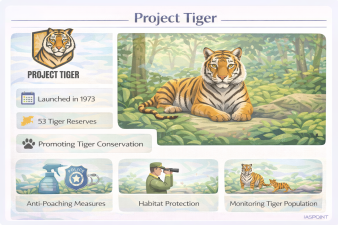
Project Tiger is a centrally sponsored scheme launched on April 1, 1973, from Jim Corbett National Park. Initiated by the Government of India during Prime Minister Indira Gandhi’s tenure, it has evolved into the world’s largest species conservation initiative.
Historical Evolution and Legal Framework
Genesis and Early Implementation
Based on the recommendations of a special task force of the Indian Board for Wildlife, the project initially covered nine tiger reserves across 18,278 sq km. The core philosophy was to create “breeding nuclei” from which surplus tigers could disperse into adjacent forests.
Statutory Evolution: NTCA
Following the 2005 Sariska tiger crisis (where the local population went extinct), the National Tiger Conservation Authority (NTCA) was established in December 2005. It was granted statutory status via the Wildlife (Protection) Amendment Act, 2006.
- Administrative Hierarchy: The NTCA is headed by the Minister for Environment, Forest and Climate Change.
- Powers and Functions:
- Approving the “Tiger Conservation Plan” prepared by State Governments.
- Setting normative standards for tourism and reserve management.
- Granting approval for any alteration in the boundaries of tiger reserves (with further approval from the National Board for Wild Life).
- Conducting the All India Tiger Estimation every four years.
Conservation Strategy: Core-Buffer Model
Tiger Reserves are managed based on a dual-zoning strategy to balance conservation and local community needs.
| Zone Type | Legal Status | Management Focus |
| Core Area | Critical Tiger Habitat (CTH) | Exclusive for wildlife; kept free of human interference and biotic disturbances. |
| Buffer/Peripheral Area | Notified under Section 38V | Provides habitat supplement; allows for “co-existence” through sustainable resource use. |
The All India Tiger Estimation (Status of Tigers in India)
The census is conducted every four years using the M-STrIPES (Monitoring System for Tigers – Intensive Protection and Ecological Status) app.
- 2022 Census Results: India’s tiger population reached 3,682 (estimated range: 3,167–3,925), accounting for nearly 75% of the global wild tiger population.
- Landscape Trends: The Shivalik hills and Gangetic plains showed significant increases, while the Western Ghats saw a slight decline in certain pockets due to habitat saturation and fragmentation.
- Tiger Density: Corbett Tiger Reserve holds the highest tiger density in India.
Network of Tiger Reserves (2026 Update)
As of April 2026, India has expanded its network to 58 Tiger Reserves across 18 states.
Recent Additions and Notable Reserves
- 58th Tiger Reserve: Madhav Tiger Reserve (Madhya Pradesh) – Serving as a crucial corridor between Ranthambore (Rajasthan) and Panna (MP).
- 57th Tiger Reserve: Ratapani Tiger Reserve (Madhya Pradesh) – Notable for surrounding the UNESCO World Heritage site of Bhimbetka.
- 56th Tiger Reserve: Guru Ghasidas-Tamor Pingla (Chhattisgarh) – Formed by merging Guru Ghasidas National Park and Tamor Pingla Wildlife Sanctuary.
- Largest Tiger Reserve: Nagarjunsagar-Srisailam (Andhra Pradesh/Telangana).
- Smallest Tiger Reserve: Bor Tiger Reserve (Maharashtra).
Key Technological and Field Initiatives
- M-STrIPES: A software-based monitoring system for patrolling and ecological status.
- E-Eye System: Thermal camera-based 24/7 surveillance used in high-risk zones like Corbett and Kaziranga.
- MST (Monitoring System for Tigers): A digital database of individual tiger photos (stripes) to track movements and identify seized body parts.
- STPF (Special Tiger Protection Force): Specially trained units deployed in sensitive reserves to check poaching and illegal human intrusion.
International Cooperation and Frameworks
Global Tiger Forum (GTF)
The only inter-governmental international body established with members from tiger-range countries (TRCs) to embark on a global campaign to save tigers. It is headquartered in New Delhi.
The St. Petersburg Declaration (TX2 Goal)
Signed in 2010 by 13 Tiger Range Countries, the goal was to double the wild tiger population by 2022. India achieved this target four years ahead of schedule (in 2018).
International Big Cats Alliance (IBCA)
Launched by India in 2023 to protect seven major big cats: Tiger, Lion, Leopard, Snow Leopard, Cheetah, Jaguar, and Puma.
Ecological Significance: The “Umbrella Species” Concept
The tiger is classified as an Umbrella Species. By protecting the tiger and its vast habitat, all other species (flora and fauna) within that ecosystem are automatically protected.
- Top Predator Role: Regulates prey populations (deer, wild boar), preventing overgrazing and maintaining forest health.
- Ecosystem Services: Tiger reserves are major carbon sinks and critical watersheds (e.g., Sunderbans protect the coast from storms).
Wildlife Protection Act (WPA) 1972 Classification
- Status: The Bengal Tiger is listed under Schedule I of the WPA, 1972, providing the highest level of legal protection.
- IUCN Status: Endangered.
- CITES: Appendix I.