
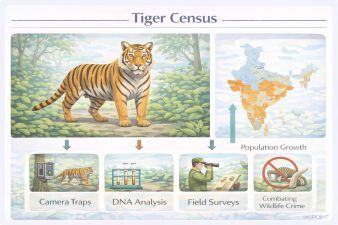
The All India Tiger Estimation (AITE) is the world’s largest wildlife survey, conducted every four years to assess the population and health of tigers, co-predators, and their habitats. In 2026, India commenced its 6th cycle of this massive scientific exercise.
Governance and Execution
- Nodal Agency: National Tiger Conservation Authority (NTCA).
- Technical Partner: Wildlife Institute of India (WII).
- Collaboration: State Forest Departments and various conservation NGOs.
- Legal Mandate: Conducted under the provisions of the Wildlife (Protection) Act, 1972 (as amended in 2006).
Evolution of Census Methodology
The transition from primitive methods to high-tech digital monitoring has made India’s tiger census a global gold standard.
- Pugmark Method: Used in early years; relied on the distinctiveness of individual tiger paw prints. It was discontinued as a primary method due to high subjectivity and inaccuracy.
- Double Sampling Method: Current scientific approach.
- Phase I (Ground Survey): Forest guards collect field data on tiger signs (scat, pugmarks, scratches) and prey abundance using the M-STrIPES mobile app.
- Phase II (Habitat Analysis): Remote sensing and GIS data are used to map vegetation and human disturbance.
- Phase III (Camera Traps): Intensive camera trapping in tiger-bearing areas to identify individual tigers through their unique stripe patterns (similar to human fingerprints).
- Software Tools:
- M-STrIPES: (Monitoring System for Tigers – Intensive Protection and Ecological Status) Digitizes patrol records and ecological data.
- CaTRAT: (Camera Trap Data Repository and Analysis Tool) Automates the identification and cataloging of millions of wildlife photographs.
Latest Census Findings (5th Cycle – 2022)
Released in 2023-24, the 5th cycle marked the 50th anniversary of Project Tiger.
| Category | Data / Statistic |
| Total Tiger Population | 3,682 (Average estimate; range: 3,167–3,925) |
| Global Share | India hosts approximately 75% of the world’s wild tigers. |
| Top State (Highest Population) | Madhya Pradesh (785 tigers) |
| Runner-up States | Karnataka (563), Uttarakhand (560), Maharashtra (444). |
| Highest Reserve Density | Jim Corbett Tiger Reserve (Uttarakhand) — 260 tigers. |
| Landscape with Growth | Shivalik Hills & Gangetic Plains; Central India. |
| Landscape with Decline | Western Ghats (specifically Wayanad and Biligiriranga Hills). |
Critical Landscape Analysis
For estimation purposes, India is divided into five distinct geographical landscapes:
- Shivalik-Gangetic Plains: Shows significant recovery; includes Corbett and Rajaji.
- Central India & Eastern Ghats: Includes the “Tiger State” MP and states like Chhattisgarh (which saw a decline).
- Western Ghats: One of the world’s biodiversity hotspots; currently facing habitat fragmentation.
- North Eastern Hills & Brahmaputra Plains: Houses genetically unique tiger populations in Kaziranga and Manas.
- Sundarbans: Unique mangrove habitat; tigers here are specially adapted to saline conditions.
Key Challenges and Trends
- Local Extirpation: Concerns remain over reserves with zero or near-zero tiger sightings, such as Dampa (Mizoram), Buxa (West Bengal), and Palamau (Jharkhand).
- Genetically Unique Populations: The tigers of Simlipal (Odisha) are noted for their unique “pseudo-melanistic” (black) traits, requiring high-priority conservation.
- Human-Wildlife Conflict: Approximately 25% to 35% of India’s tigers live outside the boundaries of protected tiger reserves, leading to frequent encounters in human-dominated landscapes.
6th Cycle (AITE 2026) Status
The 2026 Census is currently in progress.
- Phase I Fieldwork: Initiated in January 2026 across major tiger states like Tamil Nadu, Madhya Pradesh, and Karnataka.
- Expanded Scope: Increased focus on corridors and “territorial” forests outside the core reserve areas.
- Anticipated Outcome: Final report and updated numbers are expected to be released in 2027.