
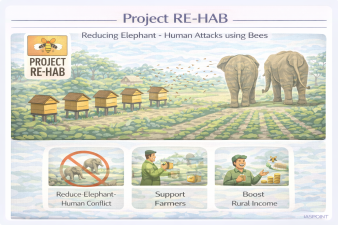
Project RE-HAB (Reducing Elephant-Human Attacks using Bees) is a unique initiative launched by the Khadi and Village Industries Commission (KVIC). It is a sub-mission under KVIC’s National Honey Mission. The project aims to create “bee-fences” to mitigate Human-Elephant Conflict (HEC) without causing physical harm to either humans or animals. It was initially launched as a pilot project in the Kodagu district of Karnataka in March 2021.
Functional Mechanism and Implementation
The core philosophy of Project RE-HAB is based on the biological behavior of elephants, who are naturally averse to honeybees.
- The Bee-Fence Strategy: Bee boxes are placed on the periphery of forest areas and human habitations. These boxes are connected with a high-tensile wire.
- Trigger Mechanism: When elephants attempt to cross the fence, the tugging of the wire causes the bees to swarm out of the boxes.
- Deterrence Factor: The buzzing and potential of stings from the bees deter elephants from entering agricultural fields or human settlements.
- Cost-Effectiveness: Unlike traditional methods like electric fencing or deep trenches, RE-HAB is low-cost and environmentally sustainable.
Strategic Significance for UPSC Prelims
The project addresses multiple goals ranging from wildlife conservation to rural livelihood.
- Mitigation of HEC: It reduces crop damage and loss of human and elephant lives.
- Boosting Rural Income: The bee boxes provide an additional source of income for farmers through honey and wax production.
- Biodiversity Conservation: The presence of bees aids in cross-pollination, improving the local flora and agricultural yields.
- Atmanirbhar Bharat: By utilizing local materials and indigenous technology, the project aligns with self-reliance goals.
Comparative Analysis: RE-HAB vs. Traditional Methods
| Feature | Project RE-HAB | Conventional Methods (Trenches/Electric Fence) |
| Cost | Minimal; investment primarily in bee boxes. | High capital and maintenance costs. |
| Safety | Non-lethal; causes temporary irritation to elephants. | High risk of electrocution or physical injury. |
| Ecological Impact | Positive; promotes pollination and bee populations. | Negative; can fragment habitats and block migration. |
| Maintenance | Low; requires periodic checking of bee colonies. | High; trenches fill with silt; fences require power. |
Geographic Expansion and Institutional Framework
Originally restricted to Karnataka, the success of the pilot led to its expansion across various states identified as high-conflict zones.
- Implementing Agency: Khadi and Village Industries Commission (KVIC), which functions under the Ministry of Micro, Small and Medium Enterprises (MSME).
- Key States Involved: Karnataka, West Bengal, Odisha, Assam, Uttarakhand, and Chhattisgarh.
- Integration with Honey Mission: The project leverages the infrastructure of the Sweet Revolution (Honey Mission) to provide training and equipment to local communities.
Facts and Trivia for Aspirants
- Elephant Status: The Indian Elephant (Elephas maximus indicus) is listed as Endangered in the IUCN Red List and under Schedule I of the Wildlife Protection Act, 1972.
- The Sound Factor: Research suggests that elephants communicate through infrasound, but they are highly sensitive to the specific frequency of honeybee buzzing, which acts as a natural psychological barrier.
- Nodal Ministry: While many environmental projects fall under the MoEFCC, Project RE-HAB is an initiative of the Ministry of MSME.
- Global Context: Similar “Beehive Fences” were successfully pioneered in Kenya by Dr. Lucy King before being adapted for the Indian context by KVIC.
Challenges and Future Outlook
While successful, the project faces specific localized challenges that require ongoing management.
- Climate Sensitivity: Bee activity is dependent on weather conditions; extreme cold or heavy monsoon can affect the efficacy of the “fence.”
- Colony Management: Farmers require technical training to maintain the health of the bee colonies and prevent absconding (bees leaving the hive).
- Scaling: To be effective across large forest ranges, the density of bee boxes must be high, requiring significant community participation.