
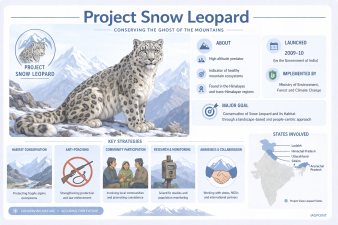
Launched in 2009, Project Snow Leopard (PSL) is a flagship initiative of the Ministry of Environment, Forest and Climate Change (MoEFCC). It is designed to safeguard the Snow Leopard (Panthera uncia), often called the “Ghost of the Mountains,” and its high-altitude habitat. The project adopts a “landscape-based approach” rather than a site-based one, focusing on the fragile Himalayan and Trans-Himalayan ecosystems across five Indian states/UTs.
Conservation Status and Significance
The Snow Leopard serves as an indicator species for the health of the mountainous ecosystem and the effects of climate change on the Himalayan water towers.
- IUCN Red List: Vulnerable (Downlisted from Endangered in 2017).
- Wildlife (Protection) Act, 1972: Schedule I (Highest protection).
- CITES: Appendix I (Strict ban on commercial international trade).
- CMS (Bonn Convention): Appendix I.
- Global Significance: India is a member of the GSLEP (Global Snow Leopard and Ecosystem Protection Program), a 12-nation alliance.
Snow Leopard Population Assessment in India (SPAI) 2024
The results of India’s first-ever scientific nationwide census (conducted 2019–2023) were released in January 2024, providing a definitive baseline for the species.
| State / UT | Estimated Population | Key Protected Areas / Habitats |
| Ladakh | 477 | Hemis National Park (High density) |
| Uttarakhand | 124 | Gangotri NP, Govind WLS, Nanda Devi BR |
| Himachal Pradesh | 51 | Pin Valley NP, Kibber WLS, Great Himalayan NP |
| Arunachal Pradesh | 36 | Namdapha NP, Dibang WLS |
| Sikkim | 21 | Khangchendzonga National Park |
| Jammu & Kashmir | 9 | Kishtwar National Park |
| Total (India) | 718 | Covering ~70% of potential habitat |
SECURE Himalaya Project
A critical component of modern snow leopard conservation is the SECURE Himalaya project (Securing livelihoods, conservation, sustainable use and restoration of high-range Himalayan ecosystems).
- Partnership: Jointly implemented by the MoEFCC and the United Nations Development Programme (UNDP).
- Funding: Supported by the Global Environment Facility (GEF).
- Focus Areas: It specifically targets landscapes in Himachal Pradesh, J&K, Uttarakhand, and Sikkim to mitigate human-wildlife conflict and ensure sustainable livelihoods for local communities (e.g., Changpa, Gaddi, Bakarwal).
Key Strategies and Initiatives
The project utilizes science-based management to address threats like poaching, habitat fragmentation, and livestock conflict.
- SPAI 2.0: In Wildlife Week 2025, the MoEFCC launched the second cycle of the population assessment to establish a long-term monitoring network.
- Snow Leopard Conservation Centre: India’s first dedicated center for snow leopard conservation was established in Uttarkashi, Uttarakhand.
- Community-Led Conservation: Implementation of livestock insurance schemes to compensate pastoralists for kills by leopards, reducing retaliatory killings.
- Landscape Management: Managing approximately 1,29,000 sq. km of high-altitude area, focusing on connectivity between habitats.
Facts and Trivia for Prelims
- Biological Adaptations: Snow leopards have a long, thick tail used for balance on rocky terrain and as a blanket for warmth while sleeping; they have large nasal cavities to breathe thin, cold air.
- Non-Roaring Cat: Unlike lions and tigers, snow leopards cannot roar due to different vocal cord physiology; they hiss, chuff, and growl.
- Himalayan Predators: Their primary prey includes the Asiatic Ibex, Blue Sheep (Bharal), Tibetan Argali, and Himalayan Marmots.
- International Big Cat Alliance (IBCA): Launched by India in 2023, the Snow Leopard is one of the seven big cats targeted for global conservation under this alliance.
- International Snow Leopard Day: Observed annually on October 23.