

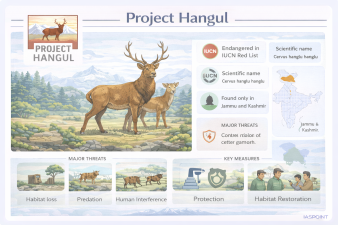
Project Hangul was launched in 1970 by the Government of Jammu & Kashmir in collaboration with the World Wildlife Fund (WWF) and the International Union for Conservation of Nature (IUCN). The primary objective is the conservation of the Kashmir Stag (locally known as Hangul), a unique subspecies of the Central Asian Red Deer and the only surviving Asiatic sub-species of the Red Deer family.
Taxonomy and Biological Profile
The Hangul’s scientific classification has evolved with recent genetic studies.
- Scientific Name: Cervus hanglu hanglu.
- Physical Traits: Recognized by a light rump patch (excluding the tail), a brown coat that brightens in summer and darkens in winter, and majestic antlers in males featuring 11 to 16 points.
- Social Behavior: They live in small groups of 2 to 18 individuals. They are herbivores, primarily feeding on shrubs, grass, and tree shoots.
- Migration Pattern: They are altitudinal migrants, moving to alpine meadows (higher altitudes) in summer and descending to valleys (lower altitudes) in winter.
Conservation Status and Legal Protection
As one of India’s most endangered mammals, the Hangul enjoys the highest level of legal protection.
- IUCN Red List: Critically Endangered.
- Wildlife (Protection) Act, 1972: Schedule I.
- CITES: Appendix I.
- J&K State Animal: Official state animal of Jammu and Kashmir.
Current Habitat and Distribution
Once widely distributed across the mountains of Kashmir and parts of Himachal Pradesh, the Hangul is now restricted to a few isolated pockets.
| Habitat Name | Type/Location | Significance |
| Dachigam National Park | Srinagar, J&K | The last viable “stronghold” containing >90% of the population. |
| Tral Wildlife Sanctuary | Pulwama, J&K | Designated as the “Second Home” of the Hangul. |
| Overa-Aru Wildlife Sanctuary | Anantnag, J&K | Part of the buffer zone and historical migratory corridor. |
| Rajparian Wildlife Sanctuary | Anantnag, J&K | High-altitude habitat supporting seasonal movement. |
| Sind Valley/Gurez Valley | North Kashmir | Recent satellite collaring confirms usage of these old migratory routes. |
Population Trends and Census (2025-2026)
Recent data indicates a slow but positive recovery from the historic lows of the mid-2000s.
- Historical Population (1940s): Estimated 3,000–5,000 individuals.
- Lowest Point (2008): Dwindled to approximately 127 individuals.
- 2023 Census: 289 individuals recorded.
- 2025 Census (Latest): 323 individuals recorded, marking the highest count in over three decades.
Major Threats to Survival
Despite the population uptick, several ecological and anthropogenic factors keep the species on the brink.
- Skewed Sex Ratio: A female-biased ratio (e.g., 23 males per 100 females) hinders effective breeding.
- Low Recruitment Rate: High fawn mortality (low fawn-to-female ratio) due to predation and lack of nutrition.
- Predation: Increased pressure from the Himalayan Black Bear and Common Leopard on fawns.
- Livestock Competition: Nomadic herders (Bakarwals) grazing livestock in Dachigam leads to habitat degradation and potential disease transmission.
- Genetic Bottleneck: Reduced genetic diversity due to population fragmentation and isolation.
Recent Conservation Initiatives
To stabilize the population, the government has intensified the Hangul Recovery Programme.
- Eco-Sensitive Zones (ESZ): In 2024, 26 villages in Pulwama (surrounding Tral Sanctuary) were declared ESZs to restrict industrial and commercial activities.
- Conservation Breeding: A specialized Hangul Breeding Centre has been operationalized at Shikargarh (Tral) to boost numbers through captive breeding.
- Satellite Collaring: Used to map migratory corridors between Dachigam and surrounding landscapes like the Sind Valley.
- Habitat Management: Removal of permanent sheep breeding farms from inside the core area of Dachigam to reduce competition for forage.