
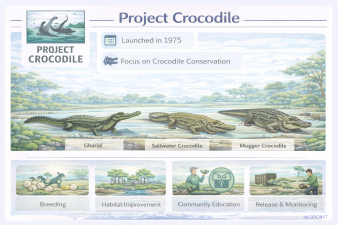
The Indian Crocodile Conservation Project was launched in 1975 to address the precipitous decline of India’s three crocodilian species, which had reached near-extinction levels by the early 1970s. It is one of the world’s most successful “rear-and-release” conservation programs, marking its 50th anniversary in 2024–25.
Administrative and Institutional Framework
The project was a pioneering international collaboration designed to rebuild populations through scientific management.
- Launch Year: 1975.
- Initial Site: Bhitarkanika National Park, Odisha.
- Implementing Agencies: Ministry of Environment, Forest and Climate Change (MoEFCC) in collaboration with the United Nations Development Programme (UNDP) and the Food and Agriculture Organization (FAO).
- Key Architect: Dr. H.R. Bustard, a world-renowned crocodile expert, provided technical guidance.
- Key Institutions: The Madras Crocodile Bank Trust (MCBT), established by Romulus Whitaker in 1976, has been a critical non-governmental partner in breeding and research.
The Three Crocodilian Species of India
India is unique globally for hosting three distinct species of crocodilians. Odisha is the only state in India where all three species are found in the wild.
| Feature | Gharial | Mugger (Marsh Crocodile) | Saltwater Crocodile |
| Scientific Name | Gavialis gangeticus | Crocodylus palustris | Crocodylus porosus |
| IUCN Status | Critically Endangered | Vulnerable | Least Concern |
| Primary Habitat | Deep, fast-flowing freshwater rivers with sand banks. | Lakes, rivers, marshes, and man-made reservoirs. | Mangrove swamps, estuaries, and coastal waters. |
| Physical Feature | Long, thin snout; males have a “Ghara” (pot) at the tip. | Broad snout; medium build. | Largest living reptile; extremely powerful. |
| Diet | Primarily piscivorous (fish-eater). | Generalist; fish, birds, mammals. | Apex predator; opportunistic. |
| Major Stronghold | National Chambal Sanctuary (MP/UP/RJ). | Widespread across 10+ states. | Bhitarkanika (Odisha), Sundarbans (WB). |
Current Status and Population Trends (2025–2026)
As of 2026, the status of the three species varies significantly, reflecting the success and ongoing challenges of the project.
- Saltwater Crocodile: A major success story. In Bhitarkanika, the population grew from 95 in 1975 to 1,826 in 2025. This area now holds the Guinness World Record for the largest white (albino) crocodile population.
- Mugger Crocodile: Most widespread and stable. Estimated population is between 8,000–10,000. It is the most versatile, even found in urban settings like Vadodara (Vishwamitri River).
- Gharial: Remains the most threatened. A landmark WII survey in 2026 recorded over 3,000 gharials across the Ganga basin, but mature breeding adults remain fewer than 800.
Conservation Strategy: The “Rear-and-Release” Technique
The project pioneered a specific conservation methodology to bypass the high mortality rate of hatchlings in the wild (which can be over 90%).
- Egg Collection: Eggs are collected from wild nests and incubated in controlled hatchery conditions.
- Captive Rearing: Hatchlings are reared in specialized pools until they reach a length of approximately 1 meter (roughly 3 years old), making them less vulnerable to predators.
- Restocking: Once they reach a size of “predator-avoidance,” they are released back into protected riverine habitats.
- Restoration of Habitat: Declaring sanctuaries like the National Chambal Sanctuary (1978) to provide safe zones for the released individuals.
Major Threats and Challenges in 2026
Despite population recovery, the species face modern anthropogenic pressures.
- Illegal Sand Mining: The Supreme Court in 2026 declared rampant sand mining in the Chambal Sanctuary an “environmental crisis,” as it destroys critical nesting beaches for Gharials.
- Habitat Fragmentation: Dams and barrages restrict the movement of Gharials, isolating populations.
- Fishing Nets: Accidental entanglement in nylon fishing nets (bycatch) leads to drowning.
- Human-Wildlife Conflict: Specifically in Bhitarkanika and the Sundarbans, rising saltwater crocodile populations have led to increased attacks on local communities.
Trivia and Key Facts for Prelims
- Indicator Species: The Gharial is an indicator of clean river water; its presence signifies a healthy, unpolluted river ecosystem.
- Ghara: The “Ghara” on a male Gharial’s snout is used for sound resonance during mating calls.
- Largest Reptile: The Saltwater Crocodile is the largest living reptile on Earth; males can reach lengths of up to 7 meters.
- World Crocodile Day: Celebrated on June 17.
- Odisha’s Record: Kendrapara district in Odisha is the only district in India where all three species (Gharial, Mugger, Saltwater) coexist.