

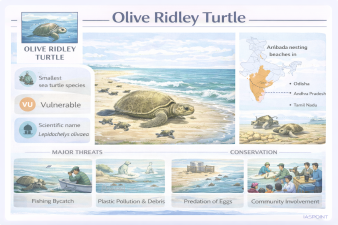
The Olive Ridley (Lepidochelys olivacea) is the smallest and most abundant of all sea turtles found in the world. They are best known for their unique mass nesting behavior called Arribada, where thousands of females come together on the same beach to lay eggs. In India, the coastline of Odisha serves as the most significant nesting ground for this species globally.
Physical Characteristics and Distribution
- Appearance: They get their name from their olive-colored, heart-shaped shell (carapace).
- Size: Adults typically grow to approximately 60–70 cm in length and weigh between 35–50 kg.
- Diet: They are primarily carnivorous, feeding on jellyfish, shrimp, snails, crabs, molluscs, and various fish.
- Habitat: Found in the warm and tropical waters of the Pacific, Indian, and Atlantic Oceans.
Conservation Status and Legal Framework
The Olive Ridley Turtle is a high-priority species for conservation due to its “Vulnerable” status and its role as a migratory species.
| Framework | Status/Schedule |
| IUCN Red List | Vulnerable |
| Wildlife Protection Act, 1972 | Schedule I (Highest legal protection) |
| CITES | Appendix I (Prohibits international commercial trade) |
| CMS (Bonn Convention) | Appendix I (Migratory species threatened with extinction) |
Mass Nesting: The Arribada Phenomenon
The word “Arribada” is Spanish for “arrival.” It refers to the synchronized mass nesting of thousands of female turtles.
- Mechanism: Females use geomagnetic imprinting and environmental cues (wind, moon phase, and tides) to return to the exact beach where they were hatched.
- Egg Laying: A single female can lay between 100 to 140 eggs in a conical nest dug in the sand.
- Incubation: Eggs hatch after approximately 45–60 days. The sex of the hatchlings is determined by the incubation temperature (higher temperatures produce more females).
Major Nesting Sites in India
While they nest sporadically along the entire Indian coast, Odisha hosts the world’s largest rookeries.
- Gahirmatha Marine Sanctuary: Located in the Kendrapara district, it is the world’s largest nesting beach for Olive Ridleys.
- Rushikulya River Mouth: A major rookery in the Ganjam district.
- Devi River Mouth: Another critical nesting site in Odisha.
- Other Sites: Sporadic nesting occurs in Hope Island (Andhra Pradesh), the Andaman and Nicobar Islands, and parts of the Maharashtra and Tamil Nadu coasts.
Key Conservation Initiatives in India
The Government of India and state authorities have launched several specific missions to protect these turtles during their breeding season (November to May).
- Operation Olivia: Conducted annually by the Indian Coast Guard since the early 1980s. It involves round-the-clock surveillance using fast patrol vessels and aircraft to enforce “no-fishing” zones near nesting sites.
- Turtle Excluder Devices (TEDs): The use of TEDs is mandatory for all mechanized trawlers in Odisha. These are specialized grids in fishing nets that allow turtles to escape while retaining the catch.
- Turtle Trails (Budget 2026 Proposal): A recent eco-tourism initiative proposed to create structured, guided access to nesting sites in Odisha, Karnataka, and Kerala to balance conservation with local livelihoods.
- Integrated Coastal Zone Management (ICZM): Helps in the restoration of nesting habitats and prevents beach erosion.
Major Threats to Survival
- Bycatch: Accidental entanglement in gillnets and trawl nets is the leading cause of adult mortality.
- Light Pollution: Artificial lights from coastal resorts and industries disorient hatchlings, which rely on the moon’s reflection on the sea to find the water.
- Climate Change: Rising sea levels submerge nesting beaches, and increased sand temperatures can skew the sex ratio of the population.
- Poaching: Illegal collection of eggs for consumption and killing of adults for meat and leather.
- Predation: Eggs and hatchlings are highly vulnerable to dogs, jackals, and birds of prey.
Trivia for UPSC Prelims
- Smallest vs. Largest: While the Olive Ridley is the smallest, the Leatherback Turtle is the largest sea turtle found in Indian waters (primarily in the Andaman and Nicobar Islands).
- Solitary vs. Social: Unlike most other sea turtles that are solitary nesters, Olive Ridleys are uniquely social during the Arribada.
- World Sea Turtle Day: Observed on June 16 to highlight the importance of conserving all turtle species.
- Navigation: They migrate over 9,000 km from feeding grounds in the South Pacific to reach the Odisha coast.