
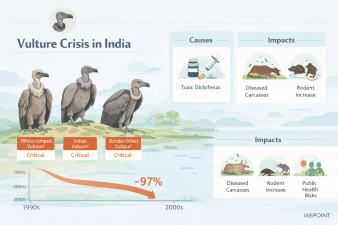
In the 1990s, India experienced one of the fastest and most catastrophic declines in any bird population globally. Vulture populations, particularly of the Gyps genus, plummeted by more than 99%, leading to a massive ecological imbalance. Vultures are “obligate scavengers” that provide a vital ecosystem service by consuming carcasses, preventing the spread of diseases like anthrax, rabies, and plague.
The Primary Culprit: Diclofenac
The decline was traced back to Diclofenac, a non-steroidal anti-inflammatory drug (NSAID) used to treat pain and inflammation in livestock.
- Mechanism of Death: When vultures feed on the carcasses of cattle recently treated with Diclofenac, they ingest the drug. It causes visceral gout and acute renal (kidney) failure in vultures.
- Toxicity: Even a tiny concentration of Diclofenac in a single carcass can kill an entire colony of vultures feeding on it.
- Government Action: The Government of India banned the veterinary use of Diclofenac in 2006. In 2015, the multi-dose vials of human Diclofenac (which were being misused for cattle) were also restricted.
Species Affected and Conservation Status
Nine species of vultures are found in India. The three Gyps species were the most severely impacted.
| Species Name | Common Name | IUCN Status |
| Gyps bengalensis | White-rumped Vulture | Critically Endangered |
| Gyps indicus | Indian Vulture (Long-billed) | Critically Endangered |
| Gyps tenuirostris | Slender-billed Vulture | Critically Endangered |
| Sarcogyps calvus | Red-headed Vulture | Critically Endangered |
| Neophron percnopterus | Egyptian Vulture | Endangered |
| Gypaetus barbatus | Bearded Vulture | Near Threatened |
| Gyps himalayensis | Himalayan Griffon | Near Threatened |
Vulture Action Plan 2020-25
To address the crisis, the Ministry of Environment, Forest and Climate Change (MoEFCC) launched a comprehensive action plan.
- Vulture Conservation Breeding Centres (VCBC): Eight centres have been established across India (e.g., Pinjore in Haryana, Rajabhatkhawa in West Bengal, and Rani in Assam) to breed vultures in captivity for future release.
- Vulture Safe Zones (VSZ): Establishing a “Vulture Safe Zone” in a 100 km radius around breeding centres where the use of toxic NSAIDs is strictly eliminated.
- Drug Regulation: Promoting the use of Meloxicam and Tolfenamic Acid as safe alternatives to Diclofenac for livestock treatment.
- Monitoring: Regular carcass sampling to check for the presence of toxic drugs in the food chain.
Ecological and Social Impact of the Crisis
The disappearance of vultures led to significant secondary consequences:
- Rise in Feral Dog Population: Without competition from vultures, the population of stray dogs at carcass dumps exploded, leading to an increase in Rabies cases.
- Carcass Disposal Issues: Decomposition of carcasses slowed down, leading to the contamination of water bodies and the spread of pathogens like Anthrax.
- Cultural Impact: The Parsi community (Zoroastrians), who rely on vultures for the disposal of their dead in Towers of Silence (Dakhmas), faced a crisis in their traditional funerary rites.
Safe vs. Toxic NSAIDs for Vultures
A key focus for UPSC is distinguishing between the drugs that are fatal and those that are safe.
| Toxic Drugs (Banned/Restricted) | Safe Alternatives (Recommended) |
| Diclofenac | Meloxicam |
| Aceclofenac (converts to Diclofenac) | Tolfenamic Acid |
| Ketoprofen | |
| Nimesulide |
Jatayu Conservation Breeding Centre (JCBC)
Located in Pinjore, Haryana, this is the world’s largest facility for the breeding and conservation of three critically endangered vulture species. It is a joint project between the Haryana Forest Department and the Bombay Natural History Society (BNHS).
Trivia for UPSC Prelims
- International Vulture Awareness Day: Observed on the first Saturday of September.
- Old World vs. New World: Indian vultures are “Old World Vultures” (rely on sight), whereas many American “New World Vultures” rely on a highly developed sense of smell.
- Bioaccumulation: Vultures are highly susceptible due to their position at the top of the scavenging food chain, where toxins accumulate.
- Saving Asia’s Vultures from Extinction (SAVE): A consortium of regional and international organizations working to coordinate vulture conservation across South Asia.