

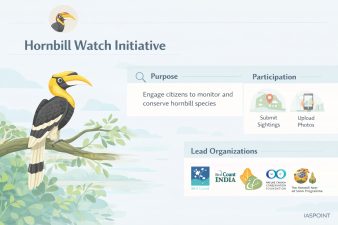
The Hornbill Watch Initiative is a citizen science program launched to document and monitor the distribution and conservation status of hornbills across India. It was started as a collaborative effort between the Nature Conservation Foundation (NCF) and the Conservation India portal. The initiative relies on “crowdsourcing” data, where common citizens, birdwatchers, and photographers contribute their sightings to build a comprehensive national database.
Significance of Hornbills
Hornbills are often called the “Farmers of the Forest” due to their ecological role and are culturally significant across various Indian states.
- Ecological Role: They are primary seed dispersers for many large-seeded tropical trees. Because they travel long distances, they are crucial for maintaining forest diversity and regenerating degraded landscapes.
- Habitat: They are found in a variety of habitats, ranging from the tropical evergreen forests of the Northeast and Western Ghats to the deciduous forests of Central India.
- Nesting Behavior: Most hornbills are cavity-nesters. The female seals herself inside a tree hollow with a mud/feces plaster during the incubation period, leaving only a narrow slit through which the male provides food.
Species of Hornbills in India
India is home to nine species of hornbills. Identifying their distribution is a core component of the Hornbill Watch data.
| Species Name | Regional Stronghold | IUCN Status |
| Great Hornbill | Western Ghats & Northeast | Vulnerable |
| Rufous-necked Hornbill | Northeast India | Vulnerable |
| Wreathed Hornbill | Northeast India | Vulnerable |
| Narcondam Hornbill | Narcondam Island (Andaman) | Vulnerable |
| Malabar Pied Hornbill | Western Ghats & Central India | Near Threatened |
| Oriental Pied Hornbill | Northeast & East India | Least Concern |
| Indian Grey Hornbill | Across Mainland India | Least Concern |
| Malabar Grey Hornbill | Western Ghats (Endemic) | Vulnerable |
| Austen’s Brown Hornbill | Northeast India | Near Threatened |
Objectives of the Initiative
The initiative aims to fill data gaps that traditional scientific surveys might miss.
- Documentation: Mapping the presence of hornbills outside protected areas, such as in plantations, urban gardens, and community forests.
- Threat Identification: Recording observations of hunting, habitat loss, or nest tree felling.
- Conservation Awareness: Engaging the public in conservation efforts by making them “stakeholders” in data collection.
- Policy Support: Providing data to the Ministry of Environment, Forest and Climate Change (MoEFCC) for better management plans.
Key Conservation Challenges
- Habitat Loss: Hornbills require large, old-growth trees with natural cavities for nesting. Logging and forest fragmentation directly impact their breeding success.
- Hunting: Some tribes in Northeast India historically hunted hornbills for their casques (the structure on top of the bill) and feathers for traditional headgear.
- Casque Trade: Illegal trade in the “ivory” of the Helmeted Hornbill (found in SE Asia, but relevant to global hornbill trade trends) has raised alarms for all species.
Successful Conservation Models in India
The data from Hornbill Watch often highlights successful community-led initiatives:
- Hornbill Nest Adoption Program (HNAP): In Arunachal Pradesh, the NCF and the Nyishi community work together. Former hunters now act as “Nest Protectors,” and urban citizens “adopt” nests by paying a yearly fee to support the protectors.
- Artificial Nests: In areas where old-growth trees have been lost, conservationists are experimenting with installing wooden nest boxes to encourage breeding.
Trivia and Key Facts for Prelims
- Narcondam Hornbill: This species has the smallest range of any hornbill in the world, restricted entirely to the Narcondam Island (an extinct volcano) in the Andamans.
- The Casque: The hollow or solid structure on top of the bill is used for vocal amplification and sometimes for “casque-butting” (aerial jousting) between males.
- State Bird: The Great Hornbill is the state bird of both Kerala and Arunachal Pradesh.
- Hornbill Festival: While the festival in Nagaland is a major cultural event, it is important to note that it is named after the bird to promote unity among tribes, though the bird’s population in Nagaland itself has faced severe pressure.
- Citizen Science Portals: Similar to Hornbill Watch, other portals like eBird and SeasonWatch also play a role in Indian biodiversity monitoring.