
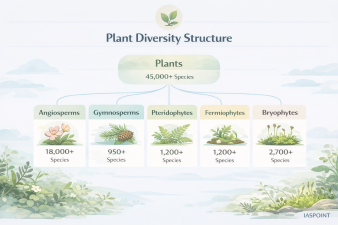
In the context of Indian floral taxonomy, the plant kingdom is broadly structured into two sub-kingdoms based on their reproductive mechanisms: Cryptogamae (non-flowering/seedless) and Phanerogamae (flowering/seed-bearing).
Cryptogamae (Non-Flowering Plants)
These plants reproduce via spores and lack visible reproductive structures. They are further divided based on the differentiation of the plant body.
- Thallophyta: Simplest structure; lack roots, stems, or leaves.
- Algae: Autotrophic, largely aquatic (e.g., Spirogyra).
- Fungi & Lichens: Symbiotic or saprophytic organisms (e.g., Parmelia).
- Bryophyta: Known as the Amphibians of the Plant Kingdom. They require water for fertilization and lack a true vascular system (e.g., Mosses, Liverworts).
- Pteridophyta: The first terrestrial plants to possess vascular tissues (Xylem and Phloem). They are often used as ornamental plants or bio-fertilizers (e.g., Ferns, Azolla).
Phanerogamae (Flowering/Seed-Bearing Plants)
These plants have well-differentiated roots, stems, and leaves and produce seeds.
- Gymnosperms: Seeds are naked (not enclosed in fruit). They are mostly perennial and woody (e.g., Pine, Deodar, Cycas).
- Angiosperms: The most dominant group where seeds are enclosed within fruits.
- Monocotyledons: Seeds with a single cotyledon (e.g., Grasses, Bamboo, Orchids).
- Dicotyledons: Seeds with two cotyledons (e.g., Mango, Peepal, Legumes).
Statistical Profile of Indian Flora (BSI 2024-25)
As per the Botanical Survey of India (BSI) Annual Report 2024-25, India’s documented floristic wealth has reached 56,177 species.
| Floral Group | Number of Species (Approx.) | Key Examples in India |
| Angiosperms | 22,368 | Orchids, Teak, Sal, Lotus |
| Gymnosperms | 83 | Himalayan Cedar, Blue Pine |
| Pteridophytes | 1,325 | Tree Ferns, Marsilea |
| Bryophytes | 2,850 | Sphagnum (Peat moss), Riccia |
| Lichens | 3,151 | Usnea, Graphis |
| Fungi | 15,986 | Mushrooms, Truffles |
| Algae | 9,117 | Sargassum, Ulva (Sea lettuce) |
Phytogeographical Divisions of India
The Botanical Survey of India (BSI) divides the country into eight distinct floristic regions based on climate and species composition.
1. Western Himalayas
Extends from Kashmir to Kumaon. Dominated by conifers like Chir Pine and Deodar. Alpine zones feature Silver Birch and Junipers.
2. Eastern Himalayas
Covers Sikkim to Arunachal Pradesh. Notable for high rainfall and high species richness, including Rhododendrons, Oaks, and a vast variety of Orchids.
3. Assam Region
Includes the Brahmaputra valley. Characterized by Evergreen forests, giant Bamboos, and tall grasses. It is a major center for wild relatives of cultivated crops.
4. Indus Plain
Arid and semi-arid regions of Punjab, Rajasthan, and Gujarat. Floral diversity includes xerophytic species like Acacia (Babool), Khejri, and various cacti.
5. Ganga Plain
The alluvial belt from UP to Bengal. Mostly under cultivation, but native pockets feature Sal, Arjun, and riverine vegetation.
6. Deccan Region
Covers the Peninsular plateau. Floral structure ranges from Dry Deciduous forests (Sal, Teak) to scrub jungles.
7. Malabar (Western Ghats)
A global biodiversity hotspot. Features Tropical Evergreen forests. Home to many endemic species like the Neelakurinji and commercial crops like Pepper and Cardamom.
8. Andaman and Nicobar Islands
Possesses unique Insular flora. Dominant types include Mangroves, Beach forests, and Evergreen rain forests.
Recent Discoveries and Trends (Trivia)
- Floral Discoveries 2024: India added 433 new plant taxa to its records in 2024 alone.
- Top States for New Species: Kerala reported the highest number of floral discoveries (58 species), followed by Maharashtra and Uttarakhand.
- Red Data Book: The BSI publishes the Red Data Book of Indian Plants, which currently lists over 1,300 species as threatened or endangered.
- Ethnobotany: Over 800 species in India are recognized for their direct use by tribal communities for medicinal or cultural purposes.