
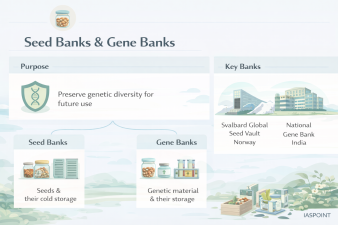
Seed banks and gene banks are specialized ex-situ conservation facilities designed to preserve genetic material (seeds, pollen, tissue, or DNA) for the long term. Their primary goal is to safeguard plant genetic resources against extinction, climate change, and natural disasters, ensuring future food security and biodiversity.
- Seed Banks: Focus specifically on storing seeds at low temperatures and low humidity.
- Gene Banks: A broader term encompassing the storage of any genetic material, including seeds, vegetative cuttings (in field gene banks), and frozen cells.
Mechanism of Seed Preservation
Seeds are categorized based on their ability to survive the drying and freezing processes required for long-term storage.
- Orthodox Seeds: These can survive significant dehydration and can be stored at sub-zero temperatures (typically -18°C to -20°C). Most major food crops like wheat, rice, and maize are orthodox.
- Recalcitrant Seeds: These do not survive drying or freezing (e.g., Mango, Rubber, Cocoa, Tea). They must be conserved via in-vitro methods or in field gene banks (living collections in orchards).
Major Facilities in India
India possesses one of the world’s most sophisticated networks for genetic resource management, led by the Indian Council of Agricultural Research (ICAR).
National Gene Bank (NGB), New Delhi
- Located at the National Bureau of Plant Genetic Resources (NBPGR).
- It is the second-largest gene bank in the world.
- It houses over 4.5 lakh accessions (samples) of various crop species and their wild relatives.
- The facility includes seed repositories, cryo-banks (using liquid nitrogen), and in-vitro conservation labs.
Chang La Seed Vault, Ladakh
- Situated at an altitude of 17,300 feet in the Himalayas.
- Established by the Defence Institute of High Altitude Research (DIHAR) under DRDO.
- It serves as a high-altitude repository where the naturally cold permafrost conditions provide a low-energy environment for seed storage.
International Frameworks
Genetic conservation is governed by international treaties to ensure fair access and benefit sharing.
Svalbard Global Seed Vault (Norway)
- Known as the “Doomsday Vault”.
- Located on the island of Spitsbergen, deep inside a sandstone mountain.
- It serves as a “backup” for all other seed banks globally. India has deposited several indigenous varieties (like rice and pearl millet) here.
International Treaty on Plant Genetic Resources for Food and Agriculture (ITPGRFA)
- Also known as the “Seed Treaty”.
- Aims at the conservation and sustainable use of plant genetic resources and the fair sharing of benefits derived from them.
Technical Conservation Methods
Different technologies are deployed based on the lifespan and nature of the plant material.
| Method | Technique | Application |
|---|---|---|
| Cryopreservation | Storage in liquid nitrogen at -196°C. | Used for non-seed tissues, pollen, and recalcitrant species. |
| In-Vitro Storage | Growth in sterile nutrient media (test tubes). | Used for vegetatively propagated plants like potato and banana. |
| Field Gene Banks | Maintaining living plants in an open field/orchard. | Essential for perennial trees and plants that cannot be stored as seeds. |
| DNA Banks | Storage of extracted genomic DNA. | Used for molecular research and biodiversity mapping. |
Key Facts for Prelims
- Longevity: Under ideal conditions (low moisture and -20°C), orthodox seeds can remain viable for hundreds of years.
- NBPGR: The nodal agency in India for the management of plant genetic resources, established in 1976.
- Wild Relatives of Crops (WRCs): Seed banks prioritize WRCs because they contain genes for drought resistance, pest resistance, and high yield that can be bred into modern crops.
- Access and Benefit Sharing (ABS): Under the Biological Diversity Act, 2002, any commercial use of genetic resources from Indian gene banks requires approval and sharing of profits with local communities.