
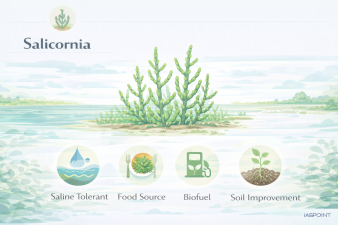
Salicornia (commonly known as sea asparagus or glasswort) is a genus of succulent, halophytic (salt-tolerant) flowering plants in the family Amaranthaceae. It typically grows in saline environments such as salt marshes, beaches, and mangroves.
Biological and Ecological Characteristics
- Halophytic Nature: Unlike most crops that perish in saline soil, Salicornia thrives on seawater. It can be irrigated with 100% seawater, making it ideal for coastal desert regions.
- Carbon Sequestration: It is a highly efficient carbon sink, absorbing atmospheric CO2 more effectively than many terrestrial plants per unit area.
- Habitat: In India, it is naturally found in the coastal regions of Gujarat (Gulf of Kutch), Andhra Pradesh, and Tamil Nadu.
Economic and Industrial Applications
The plant is often referred to as “Green Gold” due to its multi-dimensional utility.
- Nutritional Value: The succulent stems are edible and rich in minerals (potassium, magnesium, calcium) and vitamins. It is marketed as a gourmet vegetable and a salt substitute (“Green Salt”).
- Biofuel Production: The seeds contain high oil content (approx. 30%), which can be processed into biodiesel. Research indicates its potential for sustainable aviation fuel.
- Salt Alternative: The dried powder of Salicornia acts as a low-sodium vegetable salt, beneficial for patients with hypertension.
- Fodder: It can be used as nutritious forage for cattle and goats in arid coastal regions where conventional grass is unavailable.
Significance for Climate Resilience and Agriculture
- Saline Land Reclamation: Cultivating Salicornia helps in desalinating the soil over time, making it potentially suitable for other crops in the future.
- Utilization of Wasteland: India has millions of hectares of salt-affected soil. Salicornia offers an opportunity to bring “unproductive” coastal wastelands into the economic fold.
- Bio-Shield: Along with mangroves, Salicornia beds act as a natural barrier against storm surges and coastal erosion.
Key Projects and Research in India
- CSIR-CSMCRI (Central Salt and Marine Chemicals Research Institute): Based in Bhavnagar, Gujarat, this institute has pioneered the cultivation and processing technology of Salicornia brachiata in India.
- Gujarat State Fertilizer & Chemicals (GSFC): Involved in projects to promote Salicornia as a source of salt-tolerant oilseeds.
- Seawater Agriculture: Salicornia is the primary crop in Integrated Seawater Agriculture Systems (ISAS), where it is grown in tandem with aquaculture (shrimp/fish farming) to filter nutrient-rich wastewater.
Comparison: Salicornia vs. Conventional Oilseeds
| Feature | Salicornia | Conventional (e.g., Mustard/Soybean) |
| Water Requirement | Saline/Seawater | Fresh water |
| Soil Preference | Saline/Alkaline (Wasteland) | Arable/Fertile land |
| Primary Utility | Biofuel, Salt, Vegetable | Food oil, Protein |
| Environmental Impact | Carbon Sequestration/Reclamation | High input (Fertilizer/Freshwater) |
Trivia for Prelims
- The “Glasswort” Name: Historically, the ashes of Salicornia (rich in potash/soda) were used in the manufacture of glass and soap, giving it the name “Glasswort.”
- C4 Photosynthesis: Some species of Salicornia exhibit high efficiency in photosynthesis, allowing them to survive in high-temperature, high-salinity environments.
- Zero Freshwater Footprint: It is one of the few crops that can produce significant biomass with zero consumption of increasingly scarce freshwater resources.