
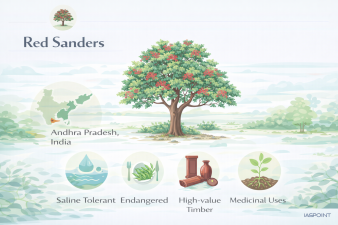
Red Sanders (Pterocarpus santalinus) is a high-value tree species endemic to a distinct tract of forests in India. Known for its rich red-colored wood, it is highly sought after in international markets, particularly in East Asia, for its use in cosmetics, medicinal products, and high-end furniture.
Geographic Distribution and Habitat
- Endemism: It is endemic to India, specifically restricted to the Seshachalam Hills, Palakonda, and Veligonda ranges of the Eastern Ghats.
- States: Primarily found in Andhra Pradesh (districts of Chittoor, Kadapa, Nellore, and Kurnool). Small patches exist in bordering areas of Tamil Nadu and Karnataka.
- Climate: It thrives in dry, hilly, and rocky terrain with a hot, dry climate. It prefers Red Lateritic soils.
- Ecological Status: It is a slow-growing tree species that takes decades to reach maturity and develop the heartwood that is commercially valuable.
Conservation and Legal Status
The legal status of Red Sanders has fluctuated due to shifts in its population and the intensity of illegal logging.
| Category | Status |
| IUCN Red List | Endangered (Reclassified from Near Threatened in 2021) |
| CITES | Appendix II (Regulates international trade to prevent over-exploitation) |
| Wildlife (Protection) Act, 1972 | Schedule IV (Afforded legal protection against unauthorized felling) |
Distinctive Properties and Uses
- Heartwood: The wood is non-aromatic (unlike Santalum album/White Sandalwood). Its deep red color is due to the presence of Santalin.
- Wave Grain: Rare specimens with a “wavy” grain pattern are extremely valuable in the international market, especially in Japan for making musical instruments like the Shamisen.
- Medicinal Use: Used in traditional medicine for treating digestive issues, skin diseases, and as an anti-inflammatory agent.
- Industrial Use: Utilized as a natural dye and in the tanning industry.
Threats and Challenges
- Smuggling: Massive illegal trade to China and Japan remains the primary threat. It is often referred to as the “Red Gold” of the Eastern Ghats.
- Forest Fires: The dry deciduous nature of its habitat makes it highly susceptible to seasonal forest fires.
- Invasive Species: Competition from invasive weeds can hinder the regeneration of young saplings.
- Slow Growth: The long gestation period makes natural recovery of the population difficult once a patch is cleared by smugglers.
Regulatory Measures and Trade
- Export Policy: The export of Red Sanders in log form is generally prohibited under India’s Foreign Trade Policy, except for confiscated stocks or wood sourced from cultivated plantations under strict license.
- Red Sanders Anti-Smuggling Task Force: A specialized force constituted by the Andhra Pradesh government to monitor the Seshachalam biosphere.
- CITES Review of Significant Trade (RST): India was removed from the CITES RST process for Red Sanders in late 2023, following improvements in conservation and reporting, which may facilitate regulated exports of plantation-grown timber.
Comparison: Red Sanders vs. White Sandalwood
| Feature | Red Sanders (Pterocarpus santalinus) | White Sandalwood (Santalum album) |
| Family | Fabaceae (Legume family) | Santalaceae |
| Fragrance | Non-aromatic | Highly aromatic (essential oils) |
| Distribution | Endemic to Eastern Ghats | Found across Peninsular India |
| Parasitism | Independent growth | Hemiparasitic (needs host plant roots) |
| Color | Deep Red/Maroon | Light Yellow/Tan |
Trivia for Prelims
- Seshachalam Biosphere Reserve: This is the primary home of Red Sanders and was designated as a Biosphere Reserve in 2010.
- Nuclear Application: There is a common (but scientifically unverified) myth in the smuggling world that Red Sanders can absorb radiation, which sometimes fuels its demand in the grey market.
- Non-Leguminous Nitrogen Fixation: While it belongs to the Fabaceae family, its primary value lies in its timber rather than agricultural nitrogen fixation.