
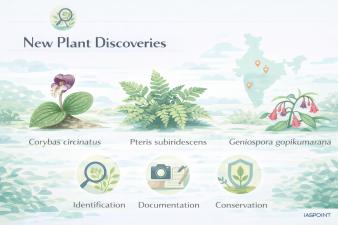
The years 2025 and 2026 have marked significant milestones in botanical research, particularly in India’s biodiversity hotspots—the Eastern Himalayas, Western Ghats, and the Aravali Range.
Key Botanical Discoveries in India (2025–2026)
The following species have been formally described and published, providing critical data for the Botanical Survey of India (BSI) and global conservation databases.
| Species Name | Family | Discovery Location | Key Characteristics |
| Fimbristylis wayanadensis | Cyperaceae (Sedge) | Wayanad, Kerala (Western Ghats) | High-altitude (1,900m) grass-like plant; chestnut-brown spikelets; triangular stems. |
| Osbeckia zubeengargiana | Melastomataceae | Manas National Park, Assam | Perennial shrub (2.5–3.5m); bright pink flower clusters; named after singer Zubeen Garg. |
| Strobilanthes riteshii | Acanthaceae | East Kameng, Arunachal Pradesh | Found at 1,600m near waterfalls; named after taxonomist Dr. Ritesh Kumar Choudhary. |
| Portulaca bharat | Portulacaceae | Galtaji Hills, Jaipur (Aravalis) | Succulent with pale-yellow flowers; thick roots; adapted to semi-arid rocky crevices. |
| Actinidia indica | Actinidiaceae | Ziro Valley, Arunachal Pradesh | A wild relative of the kiwi fruit; adds a new genus dimension to Indian flora. |
Ecological and Taxonomic Highlights
High-Altitude Adaptations: Fimbristylis wayanadensis
Discovered in April 2026, this species belongs to the sedge family, which is distinguished from true grasses by its triangular stems. It thrives in the transitional zones between rocky terrains and high-altitude grasslands of the Western Ghats. Its larger, smoother fruits with microscopic rectangular patterns distinguish it from other Fimbristylis species.
Endemism in the Aravalis: Portulaca bharat
Discovered in June 2025, this species is significant because the Aravali Range is often overlooked compared to the Himalayas. Only 10 individuals were initially found in the wild. Its naming after “Bharat” (India) serves to highlight the country’s unfolding natural heritage. It is a succulent, meaning it possesses water-storing tissues essential for survival in the dry deciduous ecosystem of Rajasthan.
Northeast India: A Biodiversity Powerhouse
The discovery of Osbeckia zubeengargiana (March 2026) in the grasslands of Manas National Park highlights the Eastern Himalayan biodiversity hotspot. Similarly, Strobilanthes riteshii (January 2026) reinforces Arunachal Pradesh’s status as a primary site for new botanical finds. The genus Strobilanthes is famous for “mass flowering” (gregarious flowering) events, such as those seen in the Neelakurinji.
Global Context: 2025 New Species Overview
In 2025, the New York Botanical Garden (NYBG) and global partners described approximately 46 new species.
- Regional Focus: Most new species were identified in the tropics of South America (Ecuador, Peru) and Southeast Asia.
- Critically Endangered Status: Many newly discovered plants, such as Sciodaphyllum merense (Ginseng family) from Ecuador, were classified as Critically Endangered immediately upon discovery due to habitat conversion for agriculture.
- Systematics and Conservation: Experts estimate that nearly 15% of flowering plants (approx. 70,000 species) remain undiscovered. Identifying these is a prerequisite for including them in the IUCN Red List for legal protection.
UPSC Prelims Facts and Trivia
- IUCN Category “Data Deficient” (DD): Most new discoveries, including Portulaca bharat and Strobilanthes riteshii, are initially categorized as DD. This indicates a lack of sufficient data on their distribution and population size to make an assessment of extinction risk.
- Biodiversity Hotspot Criteria: To qualify as a hotspot, a region must contain at least 1,500 endemic vascular plant species and have lost at least 70% of its primary native vegetation.
- International Year / Theme 2026: The theme for 2026 centers on Medicinal and Aromatic Plants (MAPs), highlighting India’s role as a global hub with over 15,000 medicinal plant species.
- New GI Tags (2025): The “Nagauri Ashwagandha” (Withania somnifera) was registered for a Geographical Indication (GI) tag in late 2025, emphasizing the intersection of traditional knowledge and botanical science.