
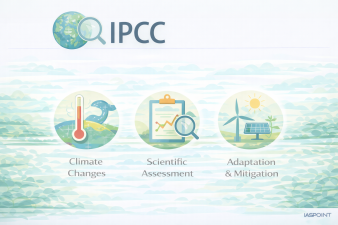
The Intergovernmental Panel on Climate Change (IPCC) is the premier United Nations body for assessing the science related to climate change. Established in 1988 by the World Meteorological Organization (WMO) and the United Nations Environment Programme (UNEP), it provides policymakers with regular scientific assessments on climate change, its implications, and potential future risks.
Governance and Institutional Framework
Mandate and Nature
- Objective: To provide a comprehensive, objective, and transparent scientific assessment of climate change, not to conduct original research.
- Member Countries: Open to all member nations of the WMO and the UN (currently 195 members).
- Neutrality: The IPCC does not prescribe policy; it is “policy-relevant but not policy-prescriptive.”
- Headquarters: Located in Geneva, Switzerland.
Internal Structure
| Component | Function |
| The Panel | Representatives of member governments meeting in plenary sessions to make major decisions. |
| The Bureau | Provides guidance on the scientific and technical aspects of assessments; members are elected by the Panel. |
| The Secretariat | Manages the day-to-day operations and coordinates work between groups. |
| Executive Committee | Addresses urgent issues that require immediate attention between Panel sessions. |
Scientific Working Groups and Task Forces
The IPCC is organized into three distinct Working Groups (WGs) and one Task Force to cover the 360° spectrum of climate science:
- Working Group I (The Physical Science Basis): Focuses on the physical science of the climate system and climate change (e.g., greenhouse gases, temperature changes).
- Working Group II (Impacts, Adaptation, and Vulnerability): Examines the socio-economic and natural system vulnerabilities and adaptation strategies.
- Working Group III (Mitigation of Climate Change): Evaluates methods for reducing greenhouse gas emissions and removing them from the atmosphere.
- Task Force on National Greenhouse Gas Inventories (TFI): Develops and refines methodologies for estimating and reporting national GHG emissions.
The Assessment Cycle and Major Reports
The IPCC produces Assessment Reports (AR) every 5–7 years, which are the most widely cited documents in global climate negotiations.
Sixth Assessment Cycle (AR6) – Completed 2023
The AR6 cycle was the most ambitious to date, culminating in the AR6 Synthesis Report (March 2023). It integrated findings from the three WGs and three Special Reports:
- Special Report on Global Warming of 1.5°C (SR15): Highlighted the urgent need to limit warming to 1.5°C compared to 2°C.
- Special Report on Climate Change and Land (SRCCL): Focused on desertification, land degradation, and food security.
- Special Report on the Ocean and Cryosphere (SROCC): Addressed rising sea levels and melting glaciers.
Seventh Assessment Cycle (AR7) – Ongoing
- Current Status: Formally began in July 2023 with the election of the new IPCC Bureau.
- Key Leadership: Jim Skea (United Kingdom) was elected as the IPCC Chair for the AR7 cycle.
- Upcoming Deliverables (Expected 2027-2029):
- Special Report on Climate Change and Cities.
- Methodology Report on Short-lived Climate Forcers.
- Methodology Report on Carbon Dioxide Removal and Carbon Capture.
Critical Facts and Trivia for UPSC
- Nobel Peace Prize: The IPCC was awarded the Nobel Peace Prize in 2007 (shared with Al Gore) for its efforts to build and disseminate knowledge about man-made climate change.
- Review Process: IPCC reports undergo a multi-stage review involving both expert reviewers and governments to ensure scientific rigor and political consensus.
- Data Source: It synthesizes peer-reviewed and selected non-peer-reviewed (grey) literature rather than gathering its own data.
- Global Stocktake (GST): The AR6 Synthesis Report served as a primary scientific input for the first-ever Global Stocktake concluded at COP28 in Dubai.
- Technical Support Units (TSUs): Each Working Group is supported by a TSU, which is often hosted by the government of the Co-Chair from a developed or developing country.
Key Findings of the Latest Assessments (AR6 Highlights)
- Warming Limit: Human activities have unequivocally caused global warming, with global surface temperature reaching 1.1°C above 1850–1900 levels in the last decade.
- Carbon Budget: To limit warming to 1.5°C, global GHG emissions must peak before 2025 and be reduced by 43% by 2030.
- Vulnerability: Approximately 3.3 to 3.6 billion people live in contexts that are highly vulnerable to climate change.
- Adaptation Gap: While adaptation planning has increased, the current financial flows for adaptation are insufficient, especially in developing nations.