
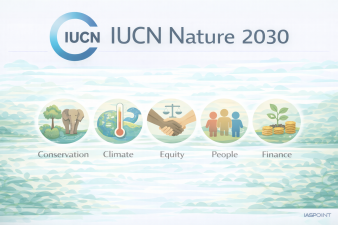
The Nature 2030 IUCN Programme is a high-level strategic roadmap adopted at the IUCN World Conservation Congress 2021 in Marseille, France.
Core Vision and Strategic Pillars
The programme is built around the theme “One Nature, One Future,” emphasizing the interconnectedness of human well-being and a healthy planet. It focuses on five priority areas known as the “Five Areas of Action”:
- People: Ensuring equitable sharing of nature’s benefits and upholding environmental human rights.
- Land: Protecting and restoring terrestrial ecosystems to halt biodiversity loss and land degradation.
- Water: Addressing the global freshwater crisis by protecting wetlands and managing water resources sustainably.
- Oceans: Scaling up marine conservation to protect 30% of the world’s oceans by 2030.
- Climate: Utilizing Nature-based Solutions (NbS) to mitigate and adapt to climate change.
Five Pathways to Transformative Change
To achieve its 2030 targets, the IUCN has identified five specific pathways that guide how the Union’s 1,400+ members and 15,000+ scientists work:
- Recognize: Acknowledging the urgency of environmental crises and the diverse knowledge systems (including Indigenous knowledge) required to solve them.
- Retain: Focusing on the conservation of existing intact ecosystems and Key Biodiversity Areas (KBAs).
- Restore: Actively rehabilitating degraded ecosystems, aligned with the UN Decade on Ecosystem Restoration.
- Resource: Mobilizing financial investment, capacity building, and knowledge generation for conservation.
- Reconnect: Re-establishing the physical links between fragmented habitats and the emotional/economic links between people and nature.
Comparison: The Shift in IUCN Programming
| Feature | Previous Programmes (4-Year) | Nature 2030 (10-Year) |
| Duration | Short-term (4 years) | Long-term (Decadal) |
| Alignment | Internal IUCN priorities | External global frameworks (SDGs, Paris Agreement, GBF) |
| Scope | Primarily species and habitat focus | Systemic transformations (Economy, Health, Justice) |
| Reporting | Secretariat-led | Contributions for Nature (Open to all Members) |
Key Initiatives and Tools under Nature 2030
Nature-based Solutions (NbS) Global Standard
Nature 2030 places NbS at the heart of climate and social policy. The IUCN provides a rigorous framework to ensure NbS projects are not just “greenwashing” but provide verifiable benefits to biodiversity and human communities.
Contributions for Nature Platform
A new digital platform launched to track the voluntary commitments of IUCN members. It allows governments and NGOs to document where they are performing conservation actions and how these contribute to global targets like the 30×30 goal (protecting 30% of land and sea by 2030).
The “Global Species Action Plan” (GSAP)
A key sub-component of Nature 2030 aimed at supporting the implementation of the Global Biodiversity Framework. It provides a roadmap for governments to prioritize species conservation within their National Biodiversity Strategies and Action Plans (NBSAPs).
India’s Alignment with Nature 2030
India, as a mega-diverse country and active IUCN State Member, has integrated Nature 2030 priorities into several national missions:
- National Red List Roadmap (2025–2030): Launched at the 2025 Abu Dhabi Congress, India aims to assess the extinction risk of 11,000 species (7,000 flora and 4,000 fauna) by 2030.
- MISHTI Scheme: Focusing on mangrove restoration, directly supporting the “Oceans” and “Climate” pillars of Nature 2030.
- Amrit Dharohar: Aimed at the conservation of Ramsar sites, aligning with the “Water” and “People” action areas.
Critical Facts for UPSC Prelims
- Democratic Adoption: The programme was voted on and adopted by both government and NGO members, reflecting a global consensus.
- COVID-19 Addendum: A specific addendum was added in 2021 to address the linkages between nature loss, zoonotic diseases (One Health approach), and human health.
- The 20-Year Vision: While Nature 2030 is the operational plan, the IUCN also operates under a broader “Strategic Vision 2045” to provide long-term continuity beyond the current decade.