

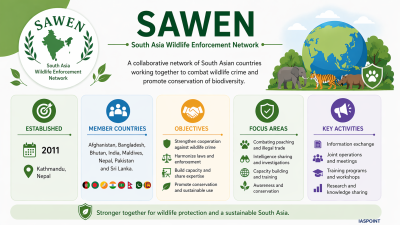
SAWEN is a regional intergovernmental body dedicated to combating illegal wildlife trade in South Asia. It serves as a collective platform for eight countries to coordinate law enforcement efforts against the transnational organized crime of wildlife trafficking, which threatens the region’s unique biodiversity.
Genesis and Institutional Framework
Historical Timeline
- 2008: The concept emerged through the Jaipur Declaration during the 11th Meeting of the Governing Council of SACEP.
- 2010: A “Road Map” was agreed upon during the First Meeting of the South Asia Experts Group on Illegal Wildlife Trade in Kathmandu.
- 2011: Officially launched in Paro, Bhutan, during the Second Meeting of the South Asia Experts Group.
- 2016: The Union Cabinet of India gave its formal approval to join SAWEN, strengthening India’s commitment to regional wildlife security.
- Headquarters: Kathmandu, Nepal.
Member Countries
SAWEN comprises the eight SAARC nations:
- Afghanistan
- Bangladesh
- Bhutan
- India
- Maldives
- Nepal
- Pakistan
- Sri Lanka
Objectives and Modus Operandi
Core Objectives
- Policy Harmonization: Working to standardize and synchronize wildlife protection laws across member nations to prevent traffickers from exploiting legal loopholes.
- Intelligence Sharing: Facilitating the exchange of information on poaching trends, trade routes, and the modus operandi of criminal networks.
- Capacity Building: Organizing regional training for forest officials, police, customs, and judicial officers on wildlife forensics and crime investigation.
- Technical Cooperation: Partnering with international bodies like INTERPOL, CITES, and TRAFFIC for advanced technical support.
Strategic Focus: Non-CITES Species
As of 2025–2026, SAWEN has significantly increased its focus on the trafficking of species not listed under CITES (Convention on International Trade in Endangered Species). This is intended to “close the gap” in legal protection for lesser-known flora and fauna that are heavily traded but lack international regulatory oversight.
Key Initiatives and Recent Developments
| Initiative | Description | Significance |
| PLEASE Project | Collaborative efforts to reduce wildlife crime and plastic pollution in shared riverine/marine habitats. | Funded by the World Bank; integrates environmental and wildlife security. |
| Zoonotic Disease Prevention | A 2025–2026 focus area linking illegal wildlife trade to the emergence of global pandemics. | Highlights the health risks of wet markets and unregulated trade. |
| OSINT Training | Training in Open Source Intelligence for enforcement officers to track illegal online wildlife sales. | Addresses the shift of wildlife markets to social media and the “dark web.” |
| MoU with Global Tiger Forum | A partnership with GTF to specifically target tiger-related crimes in the Indian subcontinent. | Focuses on the “big four” landscapes: India, Nepal, Bhutan, and Bangladesh. |
India’s Role in SAWEN
India is a pivotal member of SAWEN due to its vast borders and rich biodiversity.
- Nodal Agency: The Wildlife Crime Control Bureau (WCCB) under the MoEFCC serves as the primary focal point for SAWEN activities in India.
- Transboundary Coordination: India utilizes SAWEN to coordinate with Nepal and Bhutan for the protection of the Terai Arc Landscape and with Bangladesh for the Sundarbans.
- Legal Framework: India’s Wildlife (Protection) Amendment Act, 2022, which aligns domestic law with CITES, has been promoted within SAWEN as a model for policy harmonization.
Essential Trivia for UPSC Prelims
- Regional Specificity: South Asia is both a “source” and a “transit” hub for illegal wildlife products (like pangolin scales, tiger parts, and red sanders) moving toward East Asian markets.
- The “Six C’s”: SAWEN’s operational goal is defined by Communication, Coordination, Collaboration, Capacity building, Cooperation, and Curbing crime.
- TRAFFIC Support: The organization TRAFFIC (Trade Records Analysis of Flora and Fauna in Commerce) was the primary technical advisor during SAWEN’s formative years.
- Statute Status: SAWEN became a formal intergovernmental organization once five member countries (India, Sri Lanka, Nepal, Pakistan, and Bangladesh) ratified its Statute.
- Inter-agency Coordination: SAWEN encourages the formation of “National Wildlife Enforcement Committees” within each member country to ensure that Customs, Police, and Forest departments work in unison.