
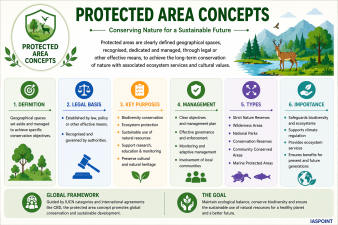
Protected Areas are geographically defined areas designated, regulated, and managed to achieve specific conservation objectives. In India, these are primarily governed by the Wildlife (Protection) Act, 1972 (WLPA). These areas serve as the backbone of biodiversity conservation, protecting flagship species, their habitats, and the associated cultural resources.
Legal Framework and Categorization
The Indian legal system recognizes several types of Protected Areas, each offering varying degrees of protection and human interference.
National Parks (NPs)
- Legal Status: Declared by both Central and State governments under Section 35 of the WLPA.
- Restriction Level: No human activity is permitted inside a National Park except that which is in the interest of wildlife and is permitted by the Chief Wildlife Warden.
- Key Distinction: Grazing and private land rights are completely prohibited within National Parks.
Wildlife Sanctuaries (WLS)
These are areas of adequate ecological significance for the purpose of protecting, propagating, or developing wildlife or its environment.
- Legal Status: Declared under Section 18 or 26A of the WLPA.
- Restriction Level: Certain human activities (like livestock grazing or collection of minor forest produce) may be permitted by the Chief Wildlife Warden, provided they do not interfere with the well-being of the wildlife.
- Boundaries: Unlike National Parks, the boundaries of sanctuaries are not always strictly fixed by legislation at the initial notification stage.
Conservation Reserves and Community Reserves
Introduced via the Wildlife (Protection) Amendment Act, 2002, these categories act as buffer zones or connectors between established NPs and Sanctuaries.
- Conservation Reserves: Declared on land owned by the Government, typically adjacent to National Parks and Sanctuaries.
- Community Reserves: Declared on community or private land where an individual or a community has volunteered to conserve wildlife and its habitat.
International Designations and Global Concepts
Beyond domestic laws, India participates in international frameworks that designate specific zones for conservation.
Biosphere Reserves (BR)
Based on the UNESCO Man and the Biosphere (MAB) Programme, these are large areas of terrestrial or coastal ecosystems. They are not a substitute for NPs or WLS but rather an overarching designation.
- Zonation System:
- Core Area: Strictly protected; contains the most undisturbed ecosystem.
- Buffer Zone: Surrounds the core; used for activities compatible with conservation like research and education.
- Transition Area: The outermost part where local communities and conservationists work together for sustainable development.
| Feature | National Park | Wildlife Sanctuary | Biosphere Reserve |
| Legislation | Wildlife (Protection) Act, 1972 | Wildlife (Protection) Act, 1972 | UNESCO MAB Program / Administrative |
| Focus | Protection of a particular species or habitat | Protection of wildlife in general | Entire Ecosystem (Flora, Fauna, Humans) |
| Human Activity | Strictly Prohibited | Regulated/Permitted | Permitted in Buffer and Transition zones |
| Size | Small to Medium | Small to Medium | Large (Often includes NPs and WLS) |
Sacred Groves
Sacred Groves are forest fragments of varying sizes, which are communally protected and usually have a significant religious connotation for the protecting community. In the 2002 amendment of the WLPA, they were brought under the “Community Reserve” category for legal protection.
Key Concepts in Protected Area Management
Buffer Zones and Eco-Sensitive Zones (ESZ)
- Eco-Sensitive Zones: These are areas notified by the Ministry of Environment, Forest and Climate Change (MoEFCC) around Protected Areas.
- Purpose: To act as a “shock absorber” for the transition from areas of high protection to areas of lesser protection.
- Extent: Usually up to 10 kilometers, but can be extended further based on ecological sensitivity.
Critical Wildlife Habitats (CWH)
Defined under the Forest Rights Act, 2006, CWHs are areas within National Parks and Sanctuaries that must be kept “inviolate” for wildlife conservation. The identification involves a scientific process and requires the informed consent of the local Gram Sabhas.
Essential Facts for Prelims
- First National Park: Corbett National Park, Uttarakhand (Established in 1936 as Hailey National Park).
- Largest National Park: Hemis National Park, Ladakh (High altitude, famous for Snow Leopards).
- Smallest National Park: South Button Island National Park, Andaman and Nicobar Islands.
- State with Highest Number of National Parks: Madhya Pradesh.
- State with Highest Number of Wildlife Sanctuaries: Andaman and Nicobar Islands.
- Marine Protected Areas (MPA): Notable examples include Gulf of Mannar Marine National Park and Gahirmatha Marine Sanctuary (Odisha).
Important Lists of Indian Protected Areas
- First Biosphere Reserve: Nilgiri Biosphere Reserve (1986).
- Only Floating National Park: Keibul Lamjao National Park, Manipur (located on Loktak Lake, famous for Sangai Deer).
- Recent Amendments: The Wildlife (Protection) Amendment Act, 2022, increased the oversight of CITES (Convention on International Trade in Endangered Species) and reorganized the schedules of protected species to simplify management.