

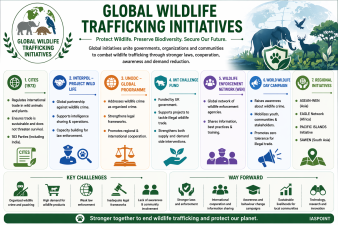
Wildlife trafficking is one of the most lucrative criminal activities globally, often linked to organized crime, money laundering, and terrorism. Unlike general conservation, trafficking initiatives focus on the “enforcement” and “criminal justice” aspects of the illegal wildlife trade (IWT).
The International Consortium on Combating Wildlife Crime (ICCWC)
The ICCWC is the premier global partnership established to bring a coordinated approach to wildlife crime. It was formally launched in 2010 at the International Forum for Tiger Conservation.
- Member Organizations: It consists of five inter-governmental organizations:
- CITES Secretariat: Provides the legal framework for international trade.
- INTERPOL: Leads global police cooperation and operational support.
- UN Office on Drugs and Crime (UNODC): Focuses on the criminal justice response and anti-corruption.
- World Bank: Provides financial support and focuses on the economic impacts of IWT.
- World Customs Organization (WCO): Enhances the capacity of customs to detect illegal shipments at borders.
- Key Tool: The ICCWC Wildlife and Forest Crime Analytic Toolkit, used by countries to assess their national response to wildlife crime.
Major Global Operational Initiatives
Practical enforcement is carried out through large-scale, multi-country operations to disrupt trafficking networks.
Operation Thunder Series
- Nature: A global law-enforcement operation coordinated annually by INTERPOL and the WCO.
- Scope: In 2025/2026, Operation Thunder involved 134 countries, resulting in thousands of seizures of illegal wildlife products, including timber, ivory, and exotic birds.
- Objective: To identify and disrupt the criminal syndicates and transit routes used for moving illegal goods across borders.
The London Declaration (2014) and Kasane/Hanoi Conferences
- Significance: High-level political commitments that recognized wildlife crime as a “serious crime” under the UN Convention against Transnational Organized Crime (UNTOC).
- Focus: Eradicating the market for illegal products, ensuring effective legal frameworks, and supporting sustainable livelihoods for communities that might otherwise turn to poaching.
Emerging Legal Frameworks (2026 Status)
As of 2026, the international community is moving toward a more robust legal structure beyond CITES.
- Global Initiative to End Wildlife Crime (EWC): This initiative advocates for a new Protocol to the UN Convention against Transnational Organized Crime (UNTOC) specifically for wildlife trafficking.
- Rationalization: While CITES regulates “trade,” it does not criminalize “trafficking” (illegal hunting/possession) at the same level as drug or human trafficking. A UNTOC Protocol would mandate states to make wildlife trafficking a serious criminal offense.
India’s Institutional and Legal Response
India’s strategy is a mix of stringent domestic law and active participation in international intelligence sharing.
Wildlife Crime Control Bureau (WCCB)
- Status: A statutory multi-disciplinary body established under the Wildlife (Protection) Act, 1972.
- Functions:
- Acts as the nodal agency for intelligence collection on organized wildlife crime.
- Maintains a centralized wildlife crime data bank.
- Coordinates with INTERPOL and the WCO for international operations.
- Awards: WCCB has frequently won the “Asia Environmental Enforcement Award” for its success in operations like Operation Wildnet (targeting online trade).
Legislative Amendments
- Wildlife (Protection) Amendment Act, 2022: This amendment aligned Indian law more closely with CITES. It introduced a new chapter for the regulation of international trade in endangered species and increased penalties for wildlife crimes significantly.
Comparison of Regulatory Approaches
| Initiative/Body | Primary Focus | Regulatory Nature |
| CITES | Trade Regulation | Legally binding on trade permits. |
| ICCWC | Law Enforcement | Collaborative partnership (Technical support). |
| WCCB (India) | Intelligence & Coordination | Statutory enforcement agency. |
| TRAFFIC | Trade Monitoring | NGO (Wildlife trade monitoring network). |
Important Facts and Trivia for UPSC
- World Wildlife Day 2026: The theme is “Medicinal and Aromatic Plants: Conserving Health, Heritage and Livelihoods,” highlighting the shift toward protecting often-overlooked plant species from illegal trade.
- The “Dirty Dozen”: While originally a chemical term, in trafficking, it refers to the 12 most frequently traded illegal wildlife products, including Rhino horn, Ivory, Tiger parts, and Pangolin scales.
- M-STrIPES: Used in India not just for census, but as a patrolling tool to detect snares and poaching activities in real-time.
- Pangolins: Currently the most trafficked mammal in the world; both Indian and Chinese Pangolins are listed in Appendix I of CITES (total ban on commercial trade).