

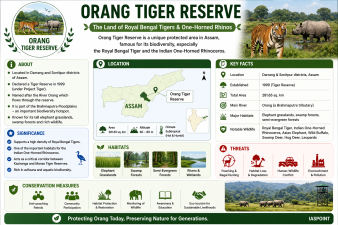
Orang Tiger Reserve, often referred to as the “Mini Kaziranga” due to its similar landscape and population of the Great Indian One-horned Rhinoceros, is located on the northern bank of the Brahmaputra River in the Udalguri and Sonitpur districts of Assam.
- Establishment History: It was established as a Sanctuary in 1985, declared a National Park in 1999, and finally notified as the 49th Tiger Reserve of India in 2016.
- Administrative Category: It is managed under the National Tiger Conservation Authority (NTCA) as part of Project Tiger.
- Size: It is the smallest Tiger Reserve in Assam, covering a core area of approximately 79.28 sq. km.
Ecological Significance and Landscape
The reserve is a critical part of the Indo-Burma biodiversity hotspot and serves as a vital link in the Brahmaputra floodplains.
- Topography: The landscape is characterized by alluvial floodplains, featuring a mosaic of eastern seasonal swamp forests, moist deciduous forests, and extensive grasslands.
- Riverine System: The park is bounded by the Brahmaputra River to the south, while the Dhansiri and Pachnoi rivers border it to the west and east, respectively.
- Geological Feature: It is situated on a series of natural terraces formed by the shifting course of the Brahmaputra over centuries.
Flora and Fauna Highlights
Despite its small size, Orang maintains a high density of flagship species, making it a “source population” for the region.
| Species Category | Key Species |
| Mammals | Royal Bengal Tiger, Great Indian One-horned Rhinoceros, Pygmy Hog, Asian Elephant, Hog Deer, and Wild Boar. |
| Avifauna | Spot-billed Pelican, Great Indian Hornbill, Bengal Florican, and various migratory waterfowl. |
| Aquatic Life | Gangetic Dolphin (found in the surrounding river waters) and various species of turtles. |
| Flora | Bombax ceiba (Silk Cotton), Dalbergia sissoo (Shisham), and various species of tall Elephant Grass (Phragmites karka). |
Critical Conservation Trivia for UPSC
- Mini Kaziranga: The nickname is derived from the fact that both parks share a similar ecosystem dominated by the Brahmaputra, resulting in nearly identical flora and fauna profiles.
- High Tiger Density: Orang is known for having one of the highest densities of tigers among India’s smaller protected areas.
- The Bengal Florican: The reserve is one of the few remaining natural habitats for the Bengal Florican, a critically endangered bird species under the IUCN Red List.
- Pygmy Hog Conservation: It serves as a secondary habitat and reintroduction site for the Pygmy Hog, the world’s smallest and rarest wild equid.
- Gharial Habitat: Recent surveys have indicated the potential for reintroducing Gharials into the river systems bordering the reserve.
Connectivity and Corridors
Orang is not an isolated ecosystem; it plays a strategic role in the Trans-Brahmaputra connectivity.
- Kaziranga-Orang Link: It acts as a “stepping stone” corridor for tigers and rhinos moving between Kaziranga National Park and the Manas National Park landscapes.
- Flood Refuge: During the monsoon, animals often use the highland areas of the reserve to escape the rising waters of the Brahmaputra, similar to the behavior seen in Kaziranga.
Threats and Management Challenges
- Erosion: Being a riverine park, it faces constant threats from bank erosion caused by the Brahmaputra.
- Siltation: Heavy siltation in the wetlands (beels) within the park reduces the depth of water bodies, affecting the habitat of rhinos and aquatic birds.
- Invasive Species: The spread of invasive weeds like Mimosa invisa poses a threat to the native grasslands.
- Encroachment: High human population density in the surrounding fringe villages leads to pressure on forest resources and occasional man-animal conflict.