
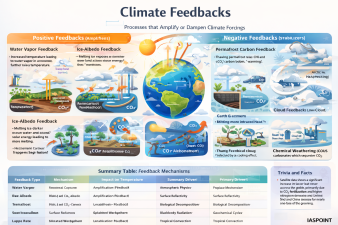
Climate feedbacks are processes that either amplify or diminish the effects of climate forcing, such as increased greenhouse gas concentrations. A Positive Feedback accelerates a temperature rise, whereas a Negative Feedback decelerates it, helping the system reach a new equilibrium.
Positive Feedback Mechanisms (Amplifiers)
Positive feedbacks are self-reinforcing cycles that exacerbate global warming.
Water Vapor Feedback
As the atmosphere warms due to anthropogenic CO2, its capacity to hold moisture increases according to the Clausius-Clapeyron relationship (roughly 7% more moisture per 1°C of warming). Since water vapor is itself a potent greenhouse gas, this extra moisture traps more heat, leading to further warming. It is considered the strongest positive feedback in the climate system.
Ice-Albedo Feedback
Albedo refers to the reflectivity of a surface.
- Process: Warming melts sea ice and glaciers, exposing darker ocean water or land surfaces.
- Result: Darker surfaces have a lower albedo (0.06 to 0.1) compared to ice (0.5 to 0.9), meaning they absorb more solar radiation, which leads to further melting.
- Geographic Focus: This is most pronounced in the Arctic, contributing to Arctic Amplification.
Permafrost Carbon Feedback
Permafrost contains vast amounts of organic carbon frozen for millennia.
- Mechanism: Rising temperatures thaw the permafrost, allowing microbes to decompose organic matter.
- Emissions: This releases Methane (CH4) in anaerobic conditions and Carbon Dioxide (CO2) in aerobic conditions.
- Tipping Point: This creates a “carbon bomb” scenario where warming becomes self-sustaining regardless of human emission cuts.
Cloud Feedbacks (High-level Clouds)
High-altitude cirrus clouds are thin and transparent to incoming solar radiation but effective at trapping outgoing longwave radiation (infrared). An increase in high-level clouds generally contributes to a net warming effect.
Negative Feedback Mechanisms (Stabilizers)
Negative feedbacks act as “brakes” on the climate system, although they are currently insufficient to offset human-induced warming.
Planck Feedback
This is the most fundamental cooling mechanism. According to the Stefan-Boltzmann Law, the energy radiated by an object increases with the fourth power of its absolute temperature (E = σ T4). As Earth warms, it emits more infrared radiation back into space, which helps stabilize the temperature.
Cloud Feedbacks (Low-level Clouds)
Thick, low-altitude clouds (stratocumulus) have a high albedo. They reflect a significant portion of incoming sunlight back into space. If warming increases the formation of these clouds, it results in a localized cooling effect.
Chemical Weathering (The Geologic Carbon Cycle)
Over millions of years, increased CO2 and higher temperatures accelerate the chemical weathering of silicate rocks.
- Reaction: CO2 dissolves in rainwater to form carbonic acid, which reacts with rocks to form carbonates.
- Sink: These carbonates eventually wash into the ocean and settle on the sea floor, removing CO2 from the atmosphere.
Summary Table: Feedback Mechanisms
| Feedback Type | Mechanism | Impact on Temperature | Primary Driver |
| Water Vapor | Increased humidity | Amplification (Positive) | Atmospheric Physics |
| Ice-Albedo | Melting of cryosphere | Amplification (Positive) | Surface Reflectivity |
| Permafrost | Methane/CO2 release | Amplification (Positive) | Biological Decomposition |
| Planck Feedback | Infrared emission | Stabilization (Negative) | Blackbody Radiation |
| Silicate Weathering | CO2 sequestration | Stabilization (Negative) | Geochemical Cycles |
| Lapse Rate | Vertical temp gradient | Stabilization (Negative) | Tropical Convection |
Key Concepts for Prelims
The Lapse Rate Feedback
In the tropics, the upper atmosphere warms faster than the surface. Since the upper atmosphere radiates heat to space more efficiently than the surface, this “lapse rate” change acts as a negative feedback. However, at the poles, the opposite occurs (Inversion), acting as a positive feedback.
Ocean Solubility Feedback
Warmer oceans are less efficient at absorbing CO2. As sea temperatures rise, the solubility of gases decreases (Henry’s Law), meaning the oceans absorb less atmospheric CO2, leaving more in the atmosphere to drive further warming.
Vegetation Feedback
This is complex and dual-natured.
- Negative: Increased CO2 can lead to “CO2 Fertilization,” increasing plant growth and carbon sequestration.
- Positive: Droughts and heatwaves caused by warming lead to forest dieback and wildfires, releasing stored carbon back into the atmosphere.
Trivia and Facts
- Global Greening: Satellite data shows a significant increase in leaf area over the last two decades, primarily in China and India, partly due to CO2 fertilization.
- Methane Hydrates: Often called “Fire Ice,” these are crystalline solids found in continental shelves. There is concern that ocean warming could trigger their sudden release, representing a massive positive feedback loop.
- The Gaia Hypothesis: Proposed by James Lovelock, it suggests that living organisms and their inorganic surroundings evolve as a single, self-regulating system to maintain the conditions for life (essentially a complex web of negative feedbacks).