
Water is the primary medium through which the impacts of climate change are felt. In India, where water security is intrinsically linked to the monsoon and glacial melt, climate-induced shifts represent a systemic risk to the economy, health, and social stability.
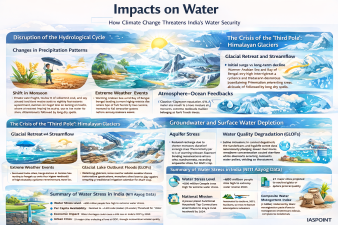
Disruption of the Hydrological Cycle
Rising global temperatures accelerate the hydrological cycle, leading to more intense but less frequent precipitation events.
Changes in Precipitation Patterns
- Shift in Monsoon: While the overall quantum of Indian Summer Monsoon Rainfall (ISMR) may remain stable or slightly increase, the spatial and temporal distribution is becoming erratic. This results in “wet droughts,” where total seasonal rainfall is normal, but it occurs in short, intense bursts followed by long dry spells.
- Extreme Weather Events: Increased sea surface temperatures in the Arabian Sea and Bay of Bengal have led to a higher frequency of high-intensity cyclones and flash floods, overwhelming traditional drainage and storage systems.
Atmosphere-Ocean Feedbacks
A warmer atmosphere holds approximately 7% more moisture per 1°C of warming (Clausius-Clapeyron equation), fueling massive storm systems while simultaneously increasing evaporation rates from surface water bodies, leading to a paradox of simultaneous floods and droughts.
The Crisis of the “Third Pole”: Himalayan Glaciers
The Himalayas, often called the “Water Tower of Asia,” feed perennial rivers like the Ganga, Indus, and Brahmaputra.
Glacial Retreat and Streamflow
- Initial Surge vs. Long-term Decline: In the short term, accelerated melting increases river discharge, raising the risk of downstream flooding. However, as glacier volume shrinks, the base flow of these rivers during the dry season will drastically decline.
- Shift in Peak Discharge: Studies on the Gangotri Glacier indicate that peak discharge is shifting from August to July due to earlier summer melting, disrupting the traditional irrigation calendar for the Kharif crop.
Glacial Lake Outburst Floods (GLOFs)
Retreating glaciers leave behind unstable lakes dammed by loose debris (moraines). Warming increases the volume of these lakes, leading to catastrophic GLOFs, such as the Chorabari Lake collapse (2013 Kedarnath disaster) and the Sikkim Lhonak Lake outburst (2023).
Groundwater and Surface Water Depletion
India is the world’s largest consumer of groundwater, and climate change acts as a “threat multiplier” for this finite resource.
Aquifer Stress
- Reduced Recharge: Shorter monsoon durations provide less time for rainwater to percolate and recharge deep aquifers.
- NASA GRACE Data: Satellite observations confirm that North India’s groundwater is receding at an alarming rate of nearly 1 foot per year, primarily due to over-extraction compounded by irregular rainfall.
Water Quality Degradation
- Saline Intrusion: In coastal regions like the Sunderbans and Gujarat, rising sea levels push saltwater into freshwater aquifers, rendering groundwater unfit for drinking or irrigation.
- Pollution Concentration: Lower river flows during dry periods reduce the “dilution capacity” of water bodies, leading to higher concentrations of pollutants and pathogens.
Summary of Water Stress in India (NITI Aayog Data)
| Indicator | Status/Projection |
| Water Stress Level | ~600 million people face high to extreme water stress |
| Per Capita Availability | Declined to ~1,100 cubic meters (Threshold for “Water Scarcity” is <1,000) |
| Economic Impact | Water shortages could cause a 6% loss in India’s GDP by 2050 |
| Urban Crisis | 21 major cities (including Delhi, Bengaluru) projected to run out of groundwater |
| Quality Index | India ranks 120th out of 122 countries in water quality |
Strategic Policy Responses
The Government of India has integrated climate resilience into water management through several flagship missions.
- Jal Jeevan Mission (JJM): Aims to provide Functional Household Tap Connections (FHTC) to every rural household by 2024, emphasizing source sustainability.
- Atal Bhujal Yojana: Focuses on community-led groundwater management in water-stressed blocks of seven states (Gujarat, Haryana, Karnataka, MP, Maharashtra, Rajasthan, and UP).
- PM Krishi Sinchayee Yojana (PMKSY): Promotes “More Crop Per Drop” through micro-irrigation to reduce the agricultural water footprint.
- National Mission for Sustaining the Himalayan Ecosystem (NMSHE): One of the eight missions under the NAPCC, specifically dedicated to monitoring glacial health and protecting Himalayan water sources.
UPSC Trivia for Prelims
- Virtual Water Trade: India is a major exporter of “virtual water” through the export of water-intensive crops like rice and sugarcane, which exacerbates domestic water scarcity.
- Composite Water Management Index (CWMI): Released by NITI Aayog, it ranks states on water management performance to foster “Competitive Federalism.”
- The 1% Fact: Although 70% of Earth is water, only about 1% is accessible freshwater. India supports 18% of the world’s population with only 4% of global freshwater resources.