
Extreme events refer to weather or climate variables that fall outside the normal range of historical observations. These events are characterized by their unusual intensity, duration, or frequency.
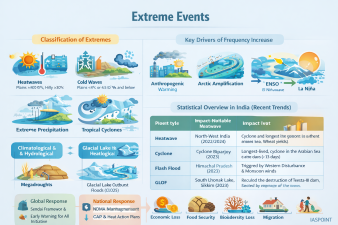
Classification and Types of Extreme Events
Extreme events are broadly categorized based on their primary atmospheric or geological drivers.
Hydro-Meteorological Extremes
- Heatwaves: Defined by the IMD when the maximum temperature of a station reaches at least 40°C for Plains and 30°C for Hilly regions.
- Cold Waves: Occur when the minimum temperature is 4°C or less in the plains, or when the departure from normal is 4.5°C to 6.4°C.
- Extreme Precipitation: Intense rainfall leading to flash floods, often linked to “Cloudbursts” (rainfall > 100mm per hour over a small area).
- Tropical Cyclones: Intense low-pressure systems forming over warm oceans; significant for India’s eastern and western coasts.
Climatological and Hydrological Extremes
- Megadroughts: Extended periods of dry conditions lasting two decades or more, driven by shifting atmospheric circulation patterns.
- Glacial Lake Outburst Floods (GLOFs): Sudden release of water from moraine-dammed lakes, a rising threat in the Himalayan region due to retreating glaciers.
Key Drivers of Increasing Frequency
The intensification of extreme events is attributed to both natural cycles and anthropogenic factors.
- Anthropogenic Global Warming: Higher temperatures increase the water-holding capacity of the atmosphere (approx. 7% per 1°C rise), leading to more intense rainfall.
- Arctic Amplification: Rapid warming of the Arctic weakens the jet stream, causing it to “meander,” which “locks” weather systems (like heatwaves or cold snaps) over a region for longer periods.
- El Niño Southern Oscillation (ENSO): El Niño typically suppresses the Indian Monsoon and increases heatwave frequency, while La Niña is associated with heavy rainfall and flooding.
- Marine Heatwaves (MHWs): Periods of abnormally high ocean temperatures that fuel rapid intensification of cyclones.
Statistical Overview of Extreme Events in India (Recent Trends)
| Event Type | Recent Notable Instance | Impact/Fact |
| Heatwave | North-West India (2022/2024) | Earliest and longest heatwaves recorded; impacted wheat yields. |
| Cyclone | Cyclone Biparjoy (2023) | Longest-lived cyclone in the Arabian Sea (approx. 13 days). |
| Flash Flood | Himachal Pradesh (2023) | Triggered by the interaction of a Western Disturbance and Monsoon winds. |
| GLOF | South Lhonak Lake, Sikkim (2023) | Resulted in the destruction of the Teesta-III dam. |
Global and National Response Frameworks
Efforts to mitigate and adapt to extreme events are governed by international treaties and domestic policies.
International Frameworks
- Sendai Framework (2015-2030): Focuses on “Building Back Better” and reducing global disaster mortality.
- Early Warnings for All (EW4All): A UN initiative to ensure every person on Earth is protected by early warning systems by 2027.
- CDRI (Coalition for Disaster Resilient Infrastructure): An Indian-led global partnership to promote the resilience of infrastructure systems to climate and disaster risks.
National Mechanisms in India
- National Disaster Management Authority (NDMA): The apex body chaired by the Prime Minister; formulates policies for disaster management.
- CAP (Common Alerting Protocol): A digital platform integrated with telecom operators to send geo-targeted disaster alerts to mobile phones.
- Heat Action Plans (HAPs): Localized strategies (pioneered by Ahmedabad) to reduce heat-related mortality through early warnings and public cooling spaces.
Ecological and Economic Consequences
Extreme events exert a multi-dimensional toll on the nation’s progress.
- Economic Loss: According to the WMO, extreme weather events cost India billions annually in lost productivity and infrastructure damage.
- Food Security: Extreme weather shifts (unseasonal rain or droughts) disrupt the Kharif and Rabi cycles, leading to food inflation.
- Biodiversity Loss: Marine heatwaves lead to coral bleaching, while terrestrial forest fires (often following heatwaves) destroy carbon sinks.
- Migration: “Climate Refugees” are increasing as extreme events render coastal and arid regions uninhabitable.
Important Facts and Trivia for Prelims
- The 1.5°C Threshold: The IPCC Special Report highlights that extreme heat events that occurred once every 50 years in a pre-industrial climate are now 4.8 times more likely.
- Urban Heat Island (UHI) Effect: Urban areas experience higher temperatures than rural surroundings due to concrete surfaces and lack of vegetation, amplifying heatwaves.
- Compound Extremes: The simultaneous occurrence of two or more extreme events (e.g., a drought followed by a flood), which complicates disaster response.
- Wet Bulb Temperature: A measure that combines heat and humidity; 35°C is considered the theoretical limit of human survivability.