
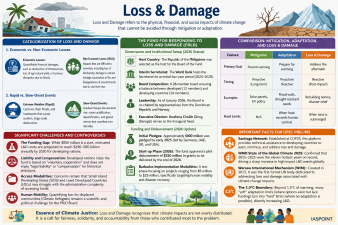
Loss and Damage refers to the physical, financial, and social impacts of climate change that cannot be avoided through mitigation (reducing emissions) or adaptation (building resilience). It represents the “residual risks” where climate impacts have already breached the limits of human or natural systems’ ability to adjust.
Categorization of Loss and Damage
L&D is classified based on the nature of the event and the type of loss incurred.
1. Economic vs. Non-Economic Losses
- Economic Losses: Quantifiable financial damages, such as destruction of infrastructure, loss of agricultural yield, or business disruption due to floods.
- Non-Economic Losses (NELS): Impacts that are difficult to monetize, including loss of biodiversity, damage to cultural heritage, trauma/loss of life, and the disappearance of ancestral lands due to sea-level rise.
2. Rapid vs. Slow-Onset Events
- Extreme Weather (Rapid): Cyclones, flash floods, and heatwaves that cause sudden, large-scale destruction.
- Slow-Onset Events: Gradual changes like sea-level rise, ocean acidification, desertification, and glacial retreat that manifest over decades.
The Fund for Responding to Loss and Damage (FRLD)
Established at COP27 (Egypt) and operationalized at COP28 (UAE), the FRLD is a dedicated financial mechanism under the UNFCCC to assist developing countries.
Governance and Institutional Setup (2026 Status)
- Host Country: The Republic of the Philippines was selected as the host for the Board of the Fund.
- Interim Secretariat: The World Bank hosts the Secretariat for an initial four-year period (2024–2028).
- Board Composition: A 26-member board ensuring a balance between developed (12 members) and developing countries (14 members).
- Leadership: As of January 2026, the Board is co-chaired by representatives from the Dominican Republic and Norway.
- Executive Director: Ibrahima Cheikh Diong (Senegal) serves as the inaugural head.
Funding and Disbursement (2026 Update)
By early 2026, the fund transitioned from “pledging” to “disbursing” mode.
- Initial Pledges: Approximately $800 million was pledged by early 2025 (led by Germany, UAE, UK, and USA).
- Start-up Phase (2026): The fund approved a pilot disbursement of $250 million in grants to be delivered by the end of 2026.
- Barbados Implementation Modalities: A test phase focusing on projects ranging from $5 million to $25 million, specifically targeting human mobility and disaster recovery.
Comparison: Mitigation, Adaptation, and L&D
| Feature | Mitigation | Adaptation | Loss & Damage |
| Primary Goal | Prevent warming | Prepare for warming | Address the aftermath |
| Timing | Proactive (Long-term) | Proactive/Reactive | Reactive (Post-impact) |
| Examples | Solar panels, EV policy | Flood walls, drought-resistant seeds | Rebuilding homes, disaster relief |
| Hard Limits | N/A | When heat exceeds human survival | When land is submerged |
Significant Challenges and Controversies
- The Funding Gap: While $800 million is a start, estimated L&D costs are projected to reach $290–580 billion annually by 2030 for developing nations.
- Liability and Compensation: Developed nations insist the fund is based on “voluntary cooperation” and does not imply “legal liability” or “compensation” for historical emissions.
- Access Modalities: Concerns remain that Small Island Developing States (SIDS) and Least Developed Countries (LDCs) may struggle with the administrative complexity of accessing funds.
- Human Mobility: Quantifying loss for displaced communities (Climate Refugees) remains a scientific and political challenge for the FRLD Board.
Important Facts for UPSC Prelims
- Santiago Network: Established at COP25, this platform provides technical assistance to developing countries to avert, minimize, and address loss and damage.
- WMO State of the Global Climate 2025: Confirmed that 2015–2025 were the eleven hottest years on record, driving a sharp increase in high-impact L&D events globally.
- Warsaw International Mechanism (WIM): Created in 2013, it was the first formal UN body dedicated to addressing loss and damage associated with climate change impacts.
- The 1.5°C Boundary: Beyond 1.5°C of warming, many “soft” adaptation limits (where options exist but lack funding) turn into “hard” limits (where no adaptation is possible), directly increasing L&D.