
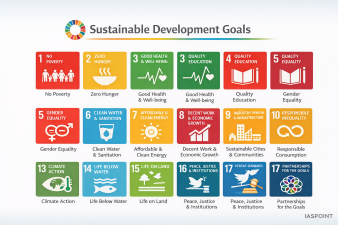
The Sustainable Development Goals (SDGs), also known as Global Goals, were adopted by all United Nations Member States in 2015 as a universal call to action to end poverty, protect the planet, and ensure that all people enjoy peace and prosperity by 2030. They succeeded the Millennium Development Goals (MDGs), which concluded in 2015.
Historical Context and Framework
The concept of sustainable development gained global traction following the 1987 Brundtland Commission Report, which defined it as “development that meets the needs of the present without compromising the ability of future generations to meet their own needs.”
- Rio+20 Conference (2012): The SDGs were conceptualized during the UN Conference on Sustainable Development in Rio de Janeiro to create a set of manageable, action-oriented targets.
- The 2030 Agenda: Formally titled “Transforming our world: the 2030 Agenda for Sustainable Development,” it comprises 17 Goals and 169 Targets.
- Five Pillars (The 5 Ps): People, Planet, Prosperity, Peace, and Partnership.
Detailed Breakdown of the 17 SDGs
| Goal Number | Objective | Key Targets & Focus Areas |
| SDG 1 | No Poverty | Eradicate extreme poverty (living on less than $2.15/day); implement social protection systems. |
| SDG 2 | Zero Hunger | End malnutrition; double agricultural productivity of small-scale food producers. |
| SDG 3 | Good Health & Well-being | Reduce maternal mortality to <70 per 100,000 live births; end epidemics of AIDS, TB, and malaria. |
| SDG 4 | Quality Education | Ensure free, equitable primary and secondary education; increase vocational skills. |
| SDG 5 | Gender Equality | End all forms of discrimination and violence against women; ensure leadership participation. |
| SDG 6 | Clean Water & Sanitation | Achieve universal access to safe drinking water and adequate sanitation. |
| SDG 7 | Affordable & Clean Energy | Increase share of renewable energy; double the global rate of energy efficiency. |
| SDG 8 | Decent Work & Economic Growth | Sustain per capita economic growth; achieve full and productive employment. |
| SDG 9 | Industry, Innovation & Infrastructure | Build resilient infrastructure; promote inclusive and sustainable industrialization. |
| SDG 10 | Reduced Inequality | Reduce income inequality within and among countries; facilitate safe migration. |
| SDG 11 | Sustainable Cities & Communities | Provide access to safe housing and basic services; protect world’s cultural and natural heritage. |
| SDG 12 | Responsible Consumption | Halve per capita global food waste; achieve environmentally sound management of chemicals. |
| SDG 13 | Climate Action | Strengthen resilience to climate-related hazards; integrate climate measures into national policies. |
| SDG 14 | Life Below Water | Conserve oceans; reduce marine pollution; regulate harvesting to end overfishing. |
| SDG 15 | Life on Land | Combat desertification; halt biodiversity loss; ensure conservation of mountain ecosystems. |
| SDG 16 | Peace, Justice & Institutions | Reduce all forms of violence; provide legal identity for all, including birth registration. |
| SDG 17 | Partnerships for the Goals | Strengthen domestic resource mobilization; enhance North-South and South-South cooperation. |
Implementation Mechanism in India
India played a pivotal role in the formulation of the SDGs, and the success of the global goals depends heavily on India’s progress.
Institutional Framework
- NITI Aayog: The nodal agency for overseeing the implementation of SDGs in India. It maps central schemes to specific SDG targets.
- Ministry of Statistics and Programme Implementation (MoSPI): Responsible for developing the National Indicator Framework (NIF) to monitor progress.
Key Monitoring Tools
- SDG India Index: Developed by NITI Aayog, it ranks States and Union Territories on their performance. States are categorized as Aspirant (0–49), Performer (50–64), Front Runner (65–99), and Achiever (100).
- Localisation of SDGs: The process of empowering Panchayati Raj Institutions (PRIs) and Urban Local Bodies (ULBs) to integrate SDGs into local development plans.
Synergies Between SDGs and Government Schemes
| SDG Goal | Related Indian Government Initiatives |
| SDG 1 & 2 | PM Garib Kalyan Anna Yojana, MGNREGA, PM-KISAN, POSHAN Abhiyaan. |
| SDG 3 | Ayushman Bharat (PM-JAY), Mission Indradhanush, Jan Aushadhi Yojana. |
| SDG 4 | National Education Policy (NEP) 2020, Samagra Shiksha, PM-SHRI. |
| SDG 5 | Beti Bachao Beti Padhao, Mahila Shakti Kendra, Sukanya Samriddhi Yojana. |
| SDG 6 | Jal Jeevan Mission, Swachh Bharat Mission (Grameen & Urban). |
| SDG 7 | PM KUSUM, UJALA Scheme, PM-SURYA GHAR: Muft Bijli Yojana. |
| SDG 9 | Make in India, PM Gati Shakti, PLI Schemes. |
| SDG 13 | National Action Plan on Climate Change (NAPCC), International Solar Alliance (ISA). |
Critical Facts and Trivia for Prelims
- The High-Level Political Forum (HLPF): This is the main United Nations platform on sustainable development and has a central role in the follow-up and review of the SDGs at the global level.
- Voluntary National Review (VNR): Countries, including India, present these reviews to the HLPF to share successes, challenges, and lessons learned.
- Financing for Development: The Addis Ababa Action Agenda (2015) provides a global framework for financing the SDGs.
- SDG Target 12.3: Specifically aims to halve per capita global food waste at the retail and consumer levels by 2030.
- SDG 16.9: Aims to provide legal identity for all, including birth registration, by 2030—a target closely linked to India’s Aadhaar system.
Global Monitoring and Challenges
- Global Sustainable Development Report (GSDR): An evidence-based instrument to support policymakers in promoting poverty eradication and sustainable development.
- Sustainable Development Report (SDR): Published annually by the Sustainable Development Solutions Network (SDSN), it includes the SDG Index and Dashboards for all UN member states.
- Current Challenges: The COVID-19 pandemic, geopolitical conflicts, and rising debt levels in developing nations have significantly stalled progress toward the 2030 targets, leading to the “SDG Stimulus” call by the UN Secretary-General.