
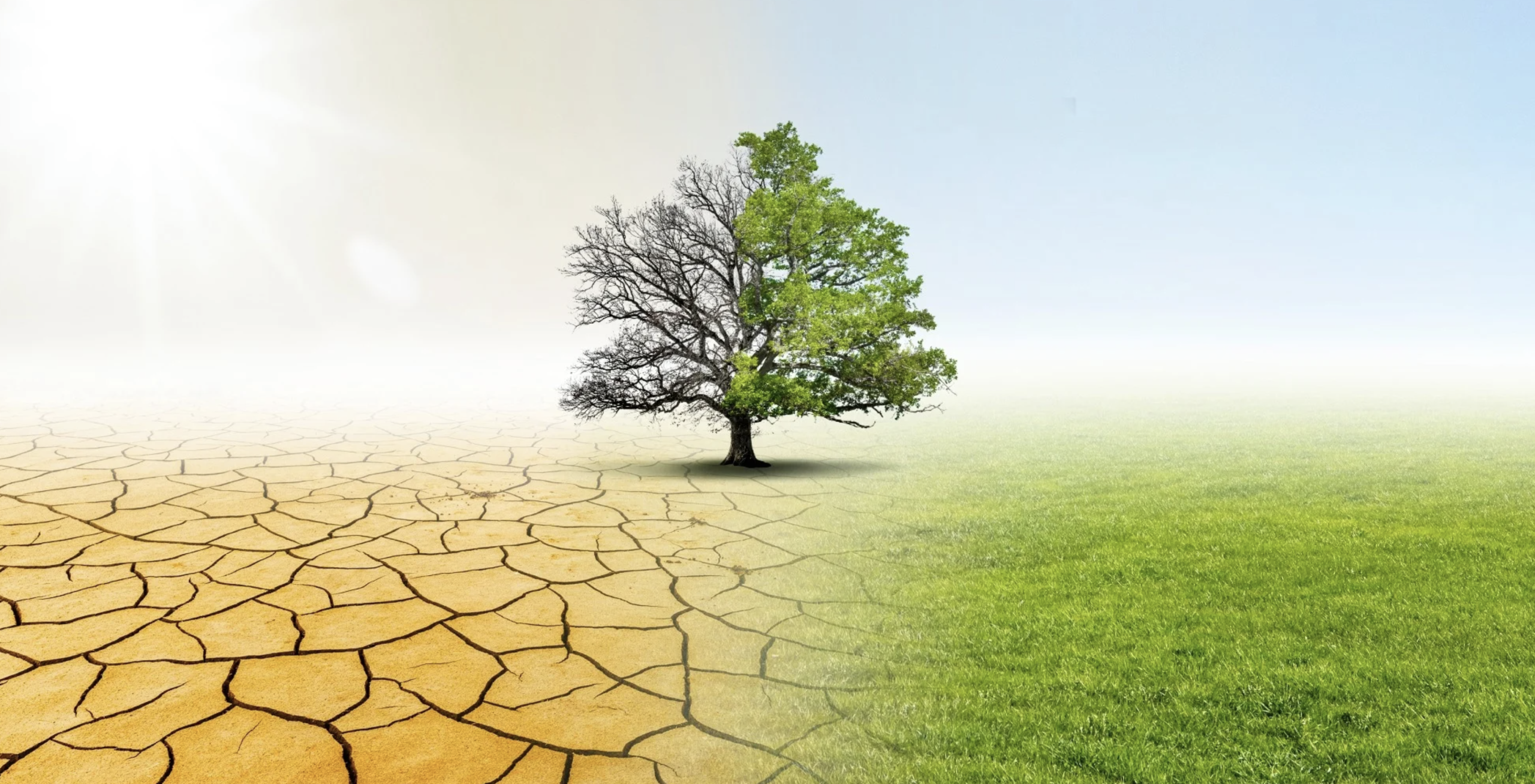
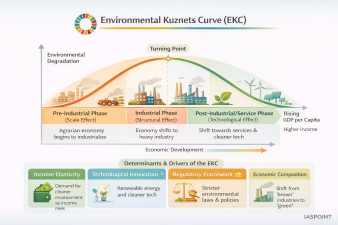
The Environmental Kuznets Curve (EKC) is a hypothesized relationship between environmental quality and economic development. It suggests that in the early stages of economic growth, environmental degradation and pollution increase, but beyond a certain level of per capita income (the “turning point”), the trend reverses, and environmental quality begins to improve.
Stages of the EKC Hypothesis
The curve typically follows an Inverted U-shape, representing three distinct phases of economic transition:
- Pre-Industrial Phase (Scale Effect): As an agrarian economy begins to industrialize, the focus is on rapid output and resource extraction. Environmental concerns are secondary to basic survival and infrastructure building, leading to rising pollution.
- Industrial Phase (Structural Effect): The economy shifts from agriculture to heavy industry. Pollution peaks at this stage due to high energy consumption and intensive manufacturing. This peak is often referred to as the Turning Point.
- Post-Industrial/Service Phase (Technological Effect): As income rises further, the economy shifts toward services and high-tech industries. Public awareness increases, leading to stricter environmental regulations, better technology, and higher spending on environmental protection, which results in a decline in degradation.
Determinants and Drivers of the EKC
The downward slope of the curve (improvement in environment) is driven by several socio-economic factors:
| Factor | Description |
| Income Elasticity | As people get wealthier, their demand for a clean environment increases, treating it as a “luxury good.” |
| Technological Innovation | Development of cleaner production processes and renewable energy sources replaces obsolete, polluting methods. |
| Regulatory Framework | Higher institutional quality and democratic governance lead to the enactment and enforcement of environmental laws. |
| Economic Composition | The transition from “brown” industries (manufacturing) to “green” industries (information, finance, and services). |
Critical Analysis and Limitations
While the EKC provides an optimistic view of development, it is subject to several criticisms relevant to global climate policy:
- The “N-shaped” Curve: Some researchers argue that environmental degradation may start increasing again at very high income levels due to massive consumption volumes, forming an “N” shape rather than an inverted U.
- Pollution Haven Hypothesis: Critics suggest that developed nations do not actually “reduce” pollution but simply outsource it by moving “dirty” manufacturing industries to developing countries.
- Irreversibility: The EKC assumes environmental damage is temporary. However, certain types of degradation, such as biodiversity loss or planetary boundary shifts, are irreversible regardless of future income.
- Applicability to CO2: While the EKC often holds true for local pollutants (like sulfur dioxide or lead), it is less consistently observed for global greenhouse gases like Carbon Dioxide (CO2), which continue to rise with GDP in many regions.
Relevance to India and Developing Nations
For a country like India, the EKC presents a policy challenge: how to “tunnel” through the curve.
- Leapfrogging Technology: India aims to bypass the peak of the EKC by adopting green technologies (like solar power) earlier in its development cycle than Western nations did.
- Policy Intervention: Initiatives like the National Action Plan on Climate Change (NAPCC) and Perform, Achieve and Trade (PAT) scheme are designed to decouple economic growth from carbon emissions.
- Turning Point Challenges: Developing nations often face the “Race to the Bottom” where environmental standards are lowered to attract foreign investment, potentially delaying the turning point of the EKC.
Trivia for UPSC Prelims
- Origin: The concept is an adaptation of Simon Kuznets’ 1950s hypothesis regarding income inequality (the original Kuznets Curve).
- Brundtland Link: The EKC is often cited in debates regarding the Brundtland Report’s focus on sustainable development.
- Global Context: The EKC was popularized by the World Bank’s 1992 World Development Report, which argued that economic growth is not the enemy of the environment but a potential solution.