
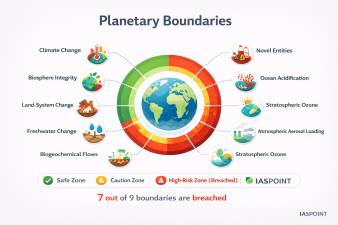
The Planetary Boundaries framework, first proposed in 2009 by a team of international scientists led by Johan Rockström (Stockholm Resilience Centre) and Will Steffen, identifies nine critical Earth system processes.
The 2025/2026 Status Update
As of the latest Planetary Health Check (2025/2026), the situation has become critical. For the first time, seven out of nine boundaries have been breached, pushing Earth into the “high-risk zone.”
| Status | Planetary Boundary | Key Indicator/Current Level |
| Breached | Climate Change | Atmospheric CO2 at 423 ppm (Safe limit: 350 ppm). |
| Breached | Biosphere Integrity | Extinction rate >10× the background rate; 90% BII. |
| Breached | Land-System Change | Global forest cover loss (especially tropical and boreal). |
| Breached | Freshwater Change | Disruption of “Blue” (rivers/lakes) and “Green” (soil) water. |
| Breached | Biogeochemical Flows | Excess Nitrogen and Phosphorus from fertilizers. |
| Breached | Novel Entities | Plastics, synthetic chemicals, and nuclear waste. |
| Breached | Ocean Acidification | Breached in 2025; pH levels falling due to CO2 absorption. |
| Stable | Stratospheric Ozone | Healing due to the Montreal Protocol; remains safe. |
| Safe Zone | Aerosol Loading | Atmospheric particulate matter; currently within limits. |
Detailed Analysis of the Nine Boundaries
1. Climate Change
Focuses on two control variables: atmospheric CO2 concentration and radiative forcing. The current trend shows accelerating global warming, with annual temperatures recently exceeding 1.5°C above pre-industrial levels.
2. Biosphere Integrity
This boundary is two-fold:
- Genetic Diversity: Measured by extinction rates. Current rates are 100 to 1,000 times higher than the natural background rate.
- Functional Diversity: The ability of ecosystems to regulate the Earth system (e.g., carbon sequestration by forests).
3. Novel Entities
This refers to “entities” created by human activity that do not occur naturally. These include microplastics, pesticides, heavy metals, and genetically modified organisms. The safe limit is essentially “zero” impact, but the volume of untested chemicals in the environment has caused a clear breach.
4. Stratospheric Ozone Depletion
The only boundary showing significant recovery. It measures the concentration of ozone (O3) in the stratosphere which filters UV radiation. International cooperation via the Montreal Protocol serves as the primary success story for this boundary.
5. Ocean Acidification
The 2025 Update: Scientists confirmed this boundary was breached in late 2025. As oceans absorb roughly 25% of human-emitted CO2, the water becomes more acidic, harming calcifying organisms like corals and shellfish and disrupting the marine food web.
6. Biogeochemical Flows
Humanity has radically altered the natural cycles of Nitrogen (N) and Phosphorus (P) through industrial agriculture.
- Nitrogen: Industrial fixation of atmospheric N2 for fertilizers far exceeds natural levels.
- Phosphorus: Runoff into oceans causes “dead zones” (hypoxia) and massive algal blooms.
7. Land-System Change
Measures the conversion of forests, grasslands, and wetlands into agricultural land or urban areas. The focus is on preserving at least 75% of the world’s original forests to maintain moisture cycles and carbon sinks.
8. Freshwater Change
This was expanded in 2023 to include two components:
- Blue Water: Surface and groundwater (rivers, aquifers).
- Green Water: Soil moisture available to plants. Both are now considered transgressed due to irrigation and climate-driven evaporation.
9. Atmospheric Aerosol Loading
Aerosols (soot, dust, sulfates) affect the climate by reflecting sunlight and influencing cloud formation. While regional levels (like in South Asia) are high and cause health issues, the global average has not yet breached the threshold.
Interconnectivity and Tipping Points
Planetary boundaries are not isolated silos; they are deeply interdependent.
- Synergistic Effects: Breaching the “Land-System Change” boundary (deforestation) weakens the “Climate Change” boundary because there are fewer trees to absorb CO2.
- Tipping Points: Crossing a boundary may trigger a “tipping point”—a threshold where a small change leads to a large, irreversible shift in the Earth system (e.g., the melting of the Greenland Ice Sheet or the dieback of the Amazon Rainforest).
Policy and Global Initiatives
Several global frameworks aim to bring humanity back within these boundaries:
- The Doughnut Economics Model: Developed by Kate Raworth, it combines “Planetary Boundaries” (environmental ceiling) with “Social Foundations” (social floor like food, water, and health).
- Kunming-Montreal Global Biodiversity Framework (GBF): Aims to protect 30% of land and sea by 2030 (“30×30” goal).
- BBNJ Treaty: Also known as the “High Seas Treaty,” it provides a legal framework for conservation in international waters, crucial for the “Ocean Acidification” boundary.