
Climate change acts as a threat multiplier, increasing the frequency, intensity, and unpredictability of hydro-meteorological disasters. While disasters are discrete events, climate change is a systemic shift that alters the baseline of environmental hazards.
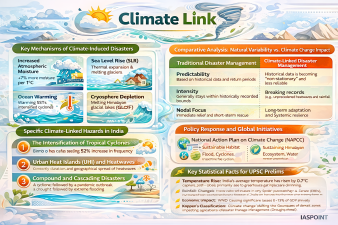
Key Mechanisms of Climate-Induced Disasters
The warming of the planet impacts the hydrological cycle and atmospheric dynamics through several specific pathways:
- Increased Atmospheric Moisture: For every 1°C of warming, the atmosphere can hold approximately 7% more moisture (Clausius-Clapeyron relationship), leading to more intense precipitation and “Cloudburst” events.
- Sea Level Rise (SLR): Thermal expansion and melting glaciers contribute to SLR, which exacerbates storm surges during cyclones and increases the risk of permanent coastal inundation.
- Ocean Warming: Warmer Sea Surface Temperatures (SSTs) provide the thermal energy required for the rapid intensification of tropical cyclones, particularly in the Arabian Sea.
- Cryosphere Depletion: Accelerated melting of Himalayan glaciers increases the formation of unstable glacial lakes, raising the risk of Glacial Lake Outburst Floods (GLOFs).
Comparative Analysis: Natural Variability vs. Climate Change Impact
| Feature | Traditional Disaster Management | Climate-Linked Disaster Management |
| Predictability | Based on historical data and return periods. | Historical data is becoming “non-stationary” and less reliable. |
| Intensity | Generally stays within historically recorded bounds. | Breaking records (e.g., unprecedented heatwaves and rainfall). |
| Nodal Focus | Immediate relief and short-term rescue. | Long-term adaptation and systemic resilience. |
| Spatial Extent | Often localized to specific hazard zones. | Widespread impact (e.g., synchronous droughts and floods). |
Specific Climate-Linked Hazards in India
1. The Intensification of Tropical Cyclones
The North Indian Ocean is witnessing a change in cyclonic patterns. While the Bay of Bengal remains the primary theater, the Arabian Sea has seen a 52% increase in the frequency of cyclonic storms. There is also a noted trend in “Rapid Intensification,” where cyclones jump multiple categories in less than 24 hours (e.g., Cyclone Amphan, Cyclone Tauktae).
2. Urban Heat Islands (UHI) and Heatwaves
Climate change has extended the duration and geographical spread of heatwaves in India. The “Urban Heat Island” effect—where concrete structures trap heat—makes cities significantly hotter than surrounding rural areas, leading to increased heat-related mortality and energy demand.
3. Compound and Cascading Disasters
India is increasingly facing “compound events,” where two or more hazards occur simultaneously or in quick succession (e.g., a cyclone followed by a pandemic outbreak or a drought followed by extreme flooding).
Policy Response and Global Initiatives
India has integrated climate action with disaster management through several strategic frameworks:
National Action Plan on Climate Change (NAPCC)
Launched in 2008, it comprises eight missions. The following are directly linked to disaster resilience:
- National Mission on Sustainable Habitat: Focuses on urban planning and flood management.
- National Mission for Sustaining the Himalayan Ecosystem: Aims to protect the cryosphere and manage GLOF risks.
- National Water Mission: Focuses on water conservation and drought resilience.
Coalition for Disaster Resilient Infrastructure (CDRI)
An Indian initiative launched at the UN Climate Action Summit (2019). It is a global partnership that aims to promote the resilience of infrastructure systems (power, transport, telecommunications) to climate and disaster risks.
The “Green” Sendai Approach
India’s domestic disaster management now emphasizes Nature-based Solutions (NbS):
- Mangrove Restoration: Acts as a bio-shield against storm surges and tsunamis (e.g., the MISHTI scheme).
- Wetland Conservation: Natural “sponges” that mitigate urban flooding by absorbing excess runoff.
Key Statistical Facts for UPSC Prelims
- Temperature Rise: India’s average temperature has risen by approximately 0.7°C between 1901–2018, primarily due to greenhouse gas-induced warming.
- Precipitation Changes: While the total seasonal rainfall remains relatively stable, there is a marked increase in “Dry Spells” punctuated by “Extreme Rainfall Events” (EREs).
- Economic Impact: According to the World Meteorological Organization (WMO), weather, climate, and water-related hazards caused significant economic losses in India, often amounting to 1-2% of the GDP annually.
- Koppen’s Classification: Climate change is shifting the boundaries of climatic zones in India, impacting agricultural disaster management (Drought/Frost).