
Environmental hazards are physical, chemical, or biological factors in the environment that can potentially impact human health or the integrity of ecosystems. Unlike purely natural disasters, environmental hazards often stem from a complex interplay between natural processes and anthropogenic activities.
Classification of Environmental Hazards
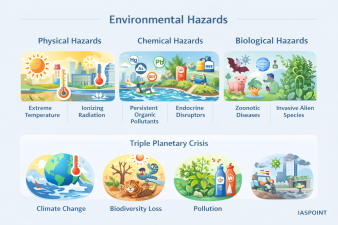
Environmental hazards are broadly categorized based on their origin and the medium through which they affect the biosphere.
1. Physical Hazards
These involve energy transfer to the human body or the environment.
- Extreme Temperature: Heatwaves and cold waves exacerbated by climate change and the Urban Heat Island (UHI) effect.
- Ionizing Radiation: Natural sources like Radon gas or anthropogenic sources like nuclear power plant leakages (e.g., Chernobyl, Fukushima).
- Noise Pollution: High decibel levels in urban industrial zones affecting physiological and psychological health.
2. Chemical Hazards
These result from the release of toxic substances into air, water, or soil.
- Heavy Metals: Lead (Pb), Mercury (Hg), Arsenic (As), and Cadmium (Cd) leaching into groundwater or entering the food chain (Bioaccumulation).
- Persistent Organic Pollutants (POPs): Chemicals like DDT and Dioxins that resist environmental degradation (regulated by the Stockholm Convention).
- Endocrine Disruptors: Chemicals that interfere with hormonal systems, such as Bisphenol A (BPA) found in plastics.
3. Biological Hazards
These include living organisms or substances produced by them that pose a threat.
- Zoonotic Diseases: Pathogens jumping from animals to humans due to habitat encroachment (e.g., COVID-19, Ebola, Nipah).
- Invasive Alien Species (IAS): Species like Lantana camara or Water Hyacinth that disrupt local biodiversity and ecosystem services.
Key Global Environmental Hazards: A Comparative Summary
| Hazard Type | Primary Cause | Impact on Health/Ecology | International Framework/Convention |
| Air Pollution | Fossil fuel combustion, Stubble burning | Respiratory diseases, Acid rain | WHO Air Quality Guidelines |
| Ocean Acidification | Increased CO2 absorption | Coral bleaching, loss of marine calcifiers | SDG 14 (Life Below Water) |
| Desertification | Overgrazing, Deforestation | Loss of arable land, forced migration | UNCCD |
| E-Waste | Rapid obsolescence of electronics | Toxic leaching of Lead and Mercury | Basel Convention |
The Concept of “Triple Planetary Crisis”
The United Nations Environment Programme (UNEP) identifies three interlinked environmental hazards that threaten human well-being and the achievement of Sustainable Development Goals (SDGs).
Climate Change
The increase in Greenhouse Gases (GHGs) leads to global warming, causing secondary hazards like sea-level rise, glacial lake outburst floods (GLOFs), and altered monsoon patterns.
Biodiversity Loss and Ecosystem Degradation
The loss of “ecosystem services” (e.g., pollination, water purification) increases vulnerability to natural disasters. The “Living Planet Report” by WWF highlights a drastic decline in vertebrate populations globally.
Pollution and Waste
Chemical waste and plastic pollution have created “dead zones” in oceans and contaminated the most remote parts of the planet, including the Mariana Trench and Mount Everest.
Environmental Hazards Specific to the Indian Subcontinent
India’s unique geography and high population density make it susceptible to specific environmental hazards.
Arsenic Contamination
Primarily found in the Ganga-Brahmaputra fluvial plains (West Bengal, Bihar, Uttar Pradesh). Long-term exposure leads to Arsenicosis, skin lesions, and cancers.
Indoor Air Pollution
The use of solid biomass for cooking (Chulhas) remains a major environmental health hazard for rural women and children, contributing to Premature Mortality.
Coastal Erosion
Driven by rising sea levels and the destruction of mangroves, particularly along the East Coast (Odisha, Andhra Pradesh) and the Sundarbans.
Institutional and Regulatory Framework in India
India has established a robust legal framework to mitigate environmental hazards.
- The Environment (Protection) Act, 1986: An “umbrella” legislation enacted in the wake of the Bhopal Gas Tragedy to provide a framework for environmental protection.
- National Green Tribunal (NGT): A specialized body equipped with the necessary expertise to handle environmental disputes involving multi-disciplinary issues.
- Central Pollution Control Board (CPCB): Tasked with monitoring air and water quality and defining standards for emissions and effluents.
- Hazardous and Other Wastes Rules, 2016: Regulates the generation, storage, and management of hazardous waste to ensure “cradle-to-grave” tracking.
Trivia and Factoids for UPSC Prelims
- Minamata Disease: Caused by Methylmercury poisoning, first discovered in Minamata City, Japan.
- Blue Baby Syndrome: Caused by high nitrate levels in drinking water (Methaemoglobinaemia).
- Itai-Itai Disease: Caused by Cadmium poisoning, leading to softening of bones and kidney failure.
- Black Carbon: A “short-lived climate pollutant” (SLCP) that has a warming effect thousands of times stronger than CO2 but remains in the atmosphere for only a few days.
- Eutrophication: The process by which a body of water becomes overly enriched with minerals and nutrients (Nitrogen/Phosphorus), leading to excessive growth of algae and depletion of dissolved oxygen.