
Environmental Impact Assessment (EIA) is a critical planning tool used to evaluate the likely environmental impacts of a proposed project or development. It integrates environmental considerations into the decision-making process to ensure that development is sustainable and minimizes damage to ecosystems.
Evolution and Statutory Framework
The concept of EIA in India has evolved from administrative decisions to a robust statutory requirement under the Environment (Protection) Act (EPA), 1986.
- Early Phase (1976-77): The Planning Commission asked the Department of Science and Technology to examine river valley projects from an environmental angle.
- The 1994 Notification: The first formal EIA notification was issued in 1994, making environmental clearance (EC) mandatory for 29 categories of activities.
- The 2006 Notification: This replaced the 1994 notification, decentralizing the process and introducing the categorization of projects based on their scale and impact.
- Draft EIA Notification 2020: A controversial proposal aiming to consolidate all previous amendments, though it faced significant legal and public scrutiny regarding “post-facto clearances.”
Categorization of Projects under EIA 2006
Projects are classified into two broad categories based on the severity of their impact and the authority responsible for clearance.
| Feature | Category A Projects | Category B Projects |
| Clearance Authority | Ministry of Environment, Forest and Climate Change (MoEFCC) | State Environment Impact Assessment Authority (SEIAA) |
| Appraisal Body | Expert Appraisal Committee (EAC) | State Expert Appraisal Committee (SEAC) |
| Impact Level | High impact; requires mandatory EIA | Moderate impact; divided into B1 and B2 |
| Screening | No screening required (EIA is mandatory) | Category B1 requires EIA; B2 is exempted |
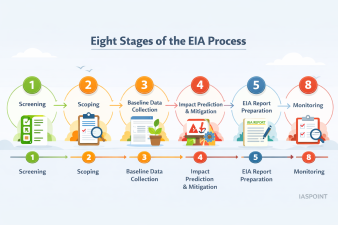
The Eight Stages of the EIA Process
The EIA process is designed to be systematic, involving multiple stakeholders from the project proponent to the general public.
1. Screening
This stage determines whether a project requires a full EIA study. Category A projects skip this as they are mandatory; Category B projects are screened by the SEAC to determine if they fall under B1 (EIA required) or B2 (Exempted).
2. Scoping
At this stage, the “Terms of Reference” (ToR) are addressed. It identifies the key environmental issues that must be studied in depth, such as air quality, water tables, or biodiversity loss.
3. Baseline Data Collection
This involves gathering environmental data for the project site and the surrounding area over a specific period (usually a season, excluding monsoon) to understand the status of the environment before the project begins.
4. Impact Prediction and Mitigation
Technical experts predict the potential positive and negative impacts of the project. A “Mitigation Plan” is then drafted to reduce or offset the negative impacts.
5. EIA Report Preparation
The project proponent prepares the Environmental Impact Statement (EIS) or EIA report, which includes the project description, baseline data, anticipated impacts, and the Environment Management Plan (EMP).
6. Public Hearing (Public Consultation)
A mandatory step for most projects where local residents and stakeholders can voice their concerns. It is conducted by the State Pollution Control Board (SPCB). Comments are recorded and must be addressed in the final EIA report.
7. Appraisal
The EAC (at the Center) or SEAC (at the State) scrutinizes the final EIA report and the outcomes of the public consultation. They then recommend the project for approval or rejection to the regulatory authority.
8. Decision Making and Monitoring
The MoEFCC or SEIAA makes the final decision. If cleared, the project must adhere to the conditions laid out in the EC. Post-clearance monitoring ensures compliance with the EMP.
Key Components of an EIA Report
- Environment Management Plan (EMP): A detailed plan outlining the measures to be taken to mitigate the environmental effects of the project.
- Risk Assessment: Identification of potential hazards (e.g., chemical leaks, dam bursts) and disaster management plans.
- Social Impact Assessment (SIA): Evaluation of the project’s impact on local communities, including displacement and loss of livelihood.
Importance and Benefits of EIA
- Sustainable Development: Ensures that economic growth does not come at the cost of long-term ecological health.
- Cost-Effectiveness: Identifying environmental risks early helps avoid legal delays and expensive remedial measures later.
- Democratic Participation: Public hearings provide a platform for marginalized communities and forest dwellers to safeguard their rights.
- Scientific Basis: Moves decision-making from arbitrary political choices to evidence-based assessments.
Challenges and Limitations
- Quality of Reports: EIA reports are often prepared by consultants paid by the project proponent, leading to potential conflicts of interest and data manipulation.
- Lack of Expertise: Local bodies and SPCBs often lack the technical capacity to scrutinize complex ecological data.
- Exemptions: Many projects are increasingly being placed in the B2 category or exempted under the guise of “strategic importance,” bypassing public scrutiny.
- Compliance Issues: Post-clearance monitoring is notoriously weak in India, with few penalties for violating environmental conditions.
Facts and Trivia for UPSC
- The Rio Declaration (1992): Principle 17 of the Rio Declaration explicitly mentions EIA as a national instrument for proposed activities likely to have a significant adverse impact on the environment.
- Central Pollution Control Board (CPCB): While the MoEFCC grants clearances, the CPCB and SPCBs provide the technical standards for air and water quality used during baseline data collection.
- Environmental Protection Act, 1986: Known as the “Umbrella Act,” it provides the legal basis for the EIA Notifications.
- National Green Tribunal (NGT): Established in 2010, the NGT is the primary judicial body where EIA clearances are challenged by environmentalists and affected parties.