

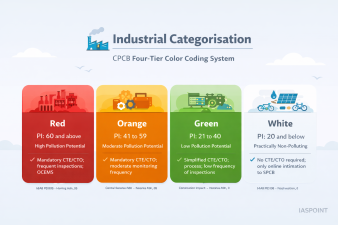
Industrial categorisation is a regulatory strategy employed by the Central Pollution Control Board (CPCB) to classify industrial sectors based on their pollution potential. This system, primarily governed by the Water (Prevention and Control of Pollution) Act, 1974 and the Air (Prevention and Control of Pollution) Act, 1981, helps in streamlining the grant of “Consents” (CTE/CTO) and determining the frequency of inspections.
The Pollution Index (PI) Methodology
The current classification is based on the Pollution Index (PI), a scientific tool developed to move away from classifications based solely on capital investment or number of workers.
- Criteria for PI Calculation: The score (0 to 100) is a function of:
- Air Pollutants (A): Emissions of SO2, NOx, Particulate Matter, etc.
- Water Pollutants (W): BOD, COD, Toxic metals, etc.
- Hazardous Wastes (H): Generation and management of toxic residues.
- Resource Consumption: Usage of fuel and water.
- Formula Logic: The PI increases with the toxicity and quantity of pollutants generated. High PI values indicate a heavy environmental footprint.
Four-Tier Color Coding System
The CPCB has categorized industries into four color-coded groups based on their PI scores. This categorization determines the level of regulatory oversight.
| Category | Pollution Index (PI) Score | Environmental Impact | Regulatory Requirement |
| Red | 60 and above | High Pollution Potential | Mandatory CTE/CTO; frequent inspections; OCEMS required. |
| Orange | 41 to 59 | Moderate Pollution Potential | Mandatory CTE/CTO; moderate monitoring frequency. |
| Green | 21 to 40 | Low Pollution Potential | Simplified CTE/CTO process; low frequency of inspections. |
| White | 20 and below | Practically Non-Polluting | No CTE/CTO required; only online intimation to SPCB. |
Key Industrial Categories Explained
1. Red Category
These industries have a significant impact on the environment and are generally not permitted in ecologically sensitive areas.
- Examples: Thermal Power Plants, Oil Refineries, Cement Plants, Distilleries, Fertilizers, and Large-scale Pharmaceuticals (API).
- Monitoring: Often required to install Online Continuous Effluent/Emission Monitoring Systems (OCEMS) that feed data directly to CPCB/SPCB servers.
2. Orange Category
These sectors have manageable pollution levels that can be mitigated through standard pollution control equipment (ETPs/STPs).
- Examples: Food processing, Brick kilns, Auto-servicing, Printing, and Multi-modal Logistic Parks.
- Compliance: Requires both Consent to Establish (CTE) and Consent to Operate (CTO).
3. Green Category
Low-impact industries that involve simple assembly or non-toxic processing.
- Examples: Rice mills, Poultry farms, Ayurvedic medicine (without extraction), and Small-scale bakery units.
- Advantage: Enjoys a faster clearance process and longer validity for CTO.
4. White Category
Introduced in 2016 to promote “Ease of Doing Business” for non-polluting sectors.
- Examples: Solar power (Photovoltaic), Wind power, Assembly of air coolers/bicycles, and Cotton spinning/weaving (without dyeing).
- Privilege: Exempted from the “Consent” regime; a self-declaration and online registration are sufficient.
Blue Category: Essential Environmental Services (Recent Development)
In recent updates (circa 2025-26), a “Blue” category has been formalized for sectors that provide Essential Environmental Services (EES).
- Purpose: To distinguish facilities that actively contribute to environmental protection.
- Examples: Common Effluent Treatment Plants (CETP), Common Hazardous Waste Treatment, Storage and Disposal Facilities (TSDF), and Municipal Solid Waste management sites.
Significance for Environmental Governance
- Objective Siting: Helps state governments decide where to locate specific industries (e.g., Red category industries are barred from “Critically Polluted Areas”).
- Resource Allocation: SPCBs can focus their limited manpower on monitoring Red and Orange units rather than wasting resources on White category units.
- Incentivizing Green Tech: Industries near a threshold (e.g., PI of 62) are incentivized to adopt cleaner technology to drop their PI below 60 and move to the Orange category, reducing their compliance burden.
- Consent Validity: * Red: 5 years.
- Orange: 10 years.
- Green: 15 years.
Trivia for UPSC Prelims
- PARIVESH Portal: All categorisation and clearance applications are now processed through this single-window hub to ensure transparency.
- Zero Liquid Discharge (ZLD): Red category industries, especially in the Ganga basin, are often mandated to achieve ZLD to prevent river pollution.
- Doon Valley Notification (1989): This was the first time the concept of “Red/Orange/Green” was introduced in India to protect the fragile ecology of Uttarakhand.
- OCEMS Connectivity: Failure to keep the real-time monitoring system connected to the CPCB server is a grounds for immediate closure notice under Section 5 of the EPA 1986.