
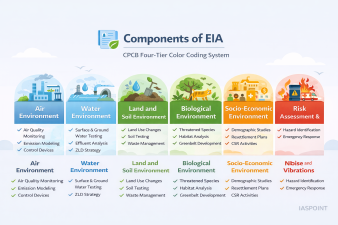
The Environmental Impact Assessment (EIA) is a multi-disciplinary study that integrates various scientific and social parameters. To ensure a 360° evaluation, the EIA report must cover specific components that provide a holistic picture of the project’s footprint.
1. Air Environment
This component focuses on the atmospheric impact of the proposed project during both construction and operational phases.
- Baseline Data: Collection of ambient air quality data (PM10, PM2.5, SOx, NOx) from several stations around the project site.
- Impact Prediction: Use of mathematical models (like AERMOD) to predict how emissions from chimneys or heavy machinery will disperse.
- Mitigation: Installation of Air Pollution Control Devices (APCD) such as Electrostatic Precipitators (ESP), scrubbers, and bag filters.
2. Water Environment
Water is a critical component, especially in water-stressed regions of India.
- Hydrogeology: Study of the water table, groundwater quality, and the impact on nearby aquifers.
- Surface Water: Assessment of impact on rivers, lakes, or coastal waters, particularly the discharge of heated water or chemical effluents.
- ZLD Strategy: Implementation of Zero Liquid Discharge (ZLD) to ensure no untreated wastewater leaves the project premises.
3. Land and Soil Environment
This covers the physical transformation of the landscape and the potential for soil degradation.
- Land Use Pattern: Analysis of how the project changes the existing land use (e.g., from agricultural or forest land to industrial use).
- Soil Quality: Testing for nutrient levels and heavy metal contamination to ensure the project does not render the surrounding land infertile.
- Solid Waste Management: Detailed plans for the disposal of fly ash, slag, or hazardous sludge.
4. Biological Environment (Flora and Fauna)
This component evaluates the impact on the local ecosystem and biodiversity.
- Ecological Sensitivity: Identification of endangered species (Schedule I species under the Wildlife Protection Act, 1972) in the study area.
- Habitat Fragmentation: Assessment of whether the project cuts through migratory corridors or destroys local breeding grounds.
- Greenbelt Development: Mandatory requirement to develop a greenbelt (usually 33% of the project area) using native species to act as a carbon sink and noise buffer.
5. Socio-Economic Environment
EIA is not just about nature; it is also about the people residing in the vicinity.
- Demographics: Analysis of the population structure, literacy rates, and employment patterns in the “impact zone” (usually a 10km radius).
- Resettlement and Rehabilitation (R&R): A comprehensive plan for those displaced by the project, ensuring their livelihoods are restored.
- Corporate Social Responsibility (CSR): Identifying local needs such as schools, hospitals, or drinking water facilities that the project proponent will fund.
6. Noise and Vibrations
Particularly relevant for mining, blasting, and heavy manufacturing sectors.
- Ambient Noise Levels: Baseline monitoring during day and night times.
- Vibration Impact: Study of how blasting or heavy machinery affects the structural integrity of nearby village houses or historical monuments.
7. Risk Assessment and Disaster Management
This component prepares the project for “worst-case scenarios.”
- Hazard Identification: Listing potential risks like gas leaks, fires, or chemical spills.
- Emergency Response Plan (ERP): A step-by-step guide for evacuation, medical aid, and fire-fighting in case of an accident.
Summary of EIA Components and Data Requirements
| Component | Key Parameters Studied | Primary Tools/Methods |
| Air | Particulate Matter, SO2, NOx, CO | Air Dispersion Modeling |
| Water | pH, BOD, COD, Heavy Metals | Groundwater Modeling |
| Noise | Decibel (dB) levels (Day/Night) | Noise Contour Mapping |
| Biology | Species Richness, Endemicity | Field Surveys & Satellite Imagery |
| Socio-Econ | Livelihood, Health, Infrastructure | Surveys & Public Hearings |
Trivia for UPSC Prelims
- The 10-km Radius: Standard EIA studies in India typically cover a “study area” of a 10-km radius from the project boundary, known as the “Impact Zone.”
- Schedule I Species: If a species listed in Schedule I of the Wildlife Protection Act is found, a site-specific Conservation Plan must be approved by the Chief Wildlife Warden.
- Micro-meteorology: EIA reports must include a “Wind Rose” diagram, which shows the prevailing wind direction and speed, crucial for predicting air pollution spread.
- Cumulative Impact: A “Cumulative EIA” is required when multiple projects (like a cluster of coal mines) are located in the same geographic area to assess their combined stress on resources.